

Class 10 Science Chapter 9 Heredity and Evolution
Are you looking for Class 10 Science Chapter 9 Heredity and Evolution notes and question answers? If yes, you are in the right place. This chapter is very important for Class 10 students and is useful for school exams, HSLC board exams, and regular revision.
In this chapter, you will learn how traits are passed from parents to their children and how living organisms change over time. Important topics include heredity, genes, chromosomes, Mendel’s experiments, inherited traits, variation, evolution, natural selection, and the origin of new species. These topics help students understand why living organisms are similar to their parents but are not exactly the same.
The notes and question answers are written in easy and simple English, so every student can understand the chapter without difficulty. Each answer is prepared according to the latest syllabus and exam pattern. The content is also helpful for quick revision before examinations.
Whether you are preparing for class tests, annual exams, or the HSLC Board Examination, these notes and solutions will help you understand the chapter better and score good marks in Science.
✨ In This Chapter, You Will Get:
- 📖 Easy Chapter Notes
- ❓ Textbook Question Answers
- ⭐ Important Questions
- 📝 Simple Explanations
- 📚 Quick Revision Notes
- 🎯 HSLC Exam Preparation
Study Class 10 Science Chapter 9 Heredity and Evolution regularly to improve your understanding and perform well in your examinations.
Class 10 Science Chapter 9 Heredity and Evolution
Questions &Answers
Q: Why are different humans included in the same species despite differences in size, shape, colour, and appearance?
Ans: Because all humans reproduce through sexual reproduction.
Q: What is meant by a hybridization experiment?
Ans: A mating experiment conducted between two organisms of the same species having contrasting traits but pure characteristics is called a hybridization experiment.
Q: How many pairs of chromosomes are present in the human body?
Ans: 23 pairs.
Q: Give an example of an acquired trait.
Ans: Loss of body weight in humans due to lack of food.
Q: What are those organs called which have different origins but appear similar and perform the same function? HSLC ’16
Ans: Analogous organs.
Q: Where did humans originate? HSLC ‘18
Ans: In Africa.
Q: What is a dominant trait? HSLC ’19
Ans: When fertilization occurs between two pure individuals having contrasting traits, the trait that appears in the first filial generation (F1 generation) is called the dominant trait.
Q: What is meant by cross-breeding?
Ans: The mating between two organisms of the same species having different characteristics is called cross-breeding.
Q: What are contrasting traits?
Ans: The opposing characteristics that express a particular trait in an organism are called contrasting traits.
Q: In Mendel’s experiment, which trait is dominant between tall and dwarf pea plants? HSLC ’17
Ans: The tall trait in pea plants is dominant.
Q: Can geographical isolation be a major factor for speciation in organisms reproducing asexually? If yes or no, why?
Ans: No. Because in asexual reproduction, one organism does not depend on another for reproduction.
Q: What is heredity? Who is known as the father of heredity?
Ans: The process by which traits are transmitted unchanged from parents to offspring is called heredity. Gregor Johann Mendel is known as the father of heredity.
Q: What is meant by cross-breeding?
Ans: The mating between two organisms of the same species having different characteristics is called cross-breeding.
Q: How did Mendel determine that traits are inherited independently through his experiments? HSLC ’18
Ans: Through his dihybrid experiments, Mendel studied two pairs of contrasting traits—seed colour (yellow Y and green y) and seed shape (round RR and wrinkled rr)—by crossing two pea plants. He observed that round shape is dominant over wrinkled, and yellow colour is dominant over green. From the results, he concluded that these traits are inherited independently of each other.
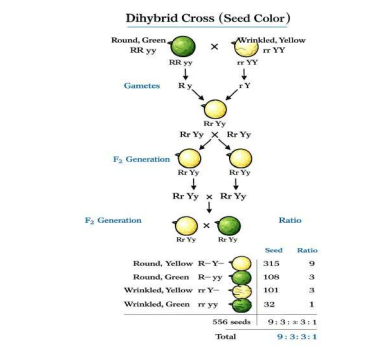
Q: Mendel conducted a dihybrid cross by considering pure yellow round (YYRR) and pure green-wrinkled (yyrr) plants as the parental generation (P1). What were the results observed?
Ans: Mendel conducted a dihybrid experiment by taking pure yellow-round (YYRR) and pure green-wrinkled (yyrr) plants as the parental generation (P1). The seeds obtained from this cross produced plants in the first filial generation (F1), all of which showed yellow-round traits. In the second filial generation (F2), along with the parental combinations (yellow-round and green-wrinkled), new combinations such as yellow-wrinkled and green-round appeared. The phenotypic ratio in the F2 generation was always 9:3:3:1.
Q: What are fossils? What do fossils tell us about evolution? HSLC ’16
Ans: Fossils are the remains or impressions of organisms preserved in the deeper layers of the Earth’s crust or rocks. Fossils provide evidence of a particular past. Based on the age of fossils, we can determine that organisms have undergone changes over different geological periods, and thus we can easily infer the process of evolution.
Q: Why do we observe more tall pea plants than dwarf pea plants in nature? HSLC ’16
Or
Why do we observe more tall pea plants than dwarf pea plants in nature?
Ans: Tallness in pea plants is controlled by a dominant allele (T), while dwarfness is controlled by a recessive allele (t). A plant needs two recessive alleles (tt) to be dwarf, but even one dominant allele (TT or Tt) makes it tall. Therefore, tall plants appear more frequently because the dominant trait is expressed in both homozygous and heterozygous conditions.
Q: Why are different humans included in the same species despite differences in size, colour, and appearance?
Ans: Although humans differ in size, shape, colour, and appearance, they are included in the same species because all humans reproduce through sexual reproduction.
Q: How is the sex of a human child determined? HSLC ’15, 17, 19
Ans: In females, there are two X chromosomes, and they produce gametes containing only X chromosomes. In males, there are both X and Y chromosomes; hence, they produce two types of gametes—half containing X chromosomes and half containing Y chromosomes. When an X-bearing sperm fertilizes the ovum, the child is female (XX). When a Y-bearing sperm fertilizes the ovum, the child is male (XY).
Q: In what ways can a particular trait of an organism increase continuously in a population?
Ans: The different ways by which a particular trait of an organism increases in a population are—
(a) Natural selection: When a variation or specific trait helps a species to survive.
(b) Genetic drift: When a particular gene becomes expressed prominently in a species.
Q: Why are acquired traits not inherited by the offspring? HSLC ’20
Ans: For survival, an organism requires a suitable environment, which is not solely controlled by genes. In this process, changes occur in somatic (nonreproductive) cells, and hence such acquired traits are not inherited by the offspring.
Q: What factors contribute to the formation of a new species? HSLC’18
Ans: The factors contributing to the formation of a new species are—
(a) Natural selection
(b) Genetic drift
(c) Environmental changes
(d) Variation
Q: An example of homologous organs is—
(a) Our arm and the forelimb of a dog
(b) Our teeth and the tusk of an elephant
(c) Potato and grass root
(d) All of the above
Ans: (d) All of the above
Q: Which of the following is generally associated with evolution?
(a) A Chinese school student
(b) A chimpanzee
(c) A spider
(d) A bacterium
Ans: (d) A bacterium
Q: How are the studies of evolution and classification interrelated?HSLC ’16, 19
Ans: Evolution is the gradual change in the characteristics of organisms over many generations due to natural selection, genetic variation, etc. Classification is the grouping of organisms based on their fundamental characteristics. Organisms having similar characteristics are considered to have a common ancestor. Thus, classification reflects evolutionary relationships.
Q: Explain homologous and analogous organs with examples. HSLC’18
Ans: Organs that have similar origin and structure but perform different functions are called homologous organs. For example: wings of birds, forelimbs of frogs, forelimbs of monkeys, wings of bats, and human hands. Organs that have different origin and structure but perform the same function are called analogous organs. For example: wings of insects, wings of birds.
Q: How is sex determined in humans?
Ans: Sex is determined by sex chromosomes (X and Y).
Q: “Genes are called the carriers of hereditary traits.” Explain.
Ans: A DNA molecule consists of two intertwined strands of nucleotides. DNA is present in chromosomes; therefore, genes are also located on chromosomes. During the formation of gametes, chromosomes carry genes into the gametes. During fertilization, genes from both parents are transferred to the offspring through chromosomes. Hence, genes are called the carriers of hereditary traits.
Q: State the law of dominance.
Ans: When two pure organisms with contrasting traits are crossed, only one of the two traits appears in the first filial generation (F1). The trait that appears is called dominant, and the one that does not appear is called recessive. This is known as the law of dominance.
Q: Why did Mendel choose pea plants for his experiments?
Ans: Mendel selected pea plants because—
(a) They have a short life cycle.
(b) They can undergo self-pollination.
(c) Their flowers are large in size.
Q: In the process of evolution, what is the process called by which new species arise due to changes in characteristics? HSLC ’19
Ans: Speciation.
Q: How does reproduction help in maintaining the stability of a species population? HSLC ‘18
Ans: Reproduction is the process by which organisms maintain their lineage. The two main features of a population are birth rate and death rate. After organisms are formed, many die due to various reasons, leading to a decrease in population. Reproduction produces new individuals to compensate for this loss. Thus, reproduction helps in maintaining the stability of a species population.
Q: How are characteristics expressed in plants and animals? HSLC’15
Ans: The characteristics of plants and animals are expressed through DNA. Offspring inherit traits from parents through gametes, which contain half the number of chromosomes. The DNA present in these chromosomes carries parental traits to the offspring, where they are expressed.
According to Mendel, factors (genes) carry traits and express them in offspring. His laws state that among a pair of contrasting traits, only one is expressed. Thus, characteristics are expressed in plants and animals.
Q: Explain the causes of speciation with examples. HSLC ’17
Ans: The main causes of speciation include genetic drift and natural selection.
For example, if plants used as food by beetles spread widely in a region, the beetle population increases. Some beetles may spend their entire life feeding on nearby plants, forming subgroups. These subgroups often reproduce within themselves. Occasionally, some beetles may move from one subgroup to another, causing limited gene flow. Over many generations, genetic drift occurs, leading to variations in each group. Natural selection also plays a role in modifying traits in geographically isolated subgroups, eventually leading to the formation of new species.
Q: Why do we observe more tall pea plants than dwarf pea plants in nature?
(a) Due to environmental factors
(b) Due to competition
(c) Due to tall trait is dominant over the dwarf trait
(d) None of the above
Ans: (c) Due to tall trait is dominant over the dwarf trait
Q: Humans originated in—
(a) Asia
(b) Africa
(c) Australia
(d) Europe
Ans: (b) Africa
Q: Who is known as the father of heredity?
(a) Albert Einstein
(b) Charles Darwin
(c) Gregor Johann Mendel
(d) Robert Hooke
Ans: (c) Gregor Johann Mendel
Q: If a cross is made between plants with genotype tall (TT) and dwarf(tt), what type of plants will appear in the next generation?
(a) Both tall (TT) and dwarf (tt)
(b) Only tall
(c) Only dwarf
(d) None of these
Ans: (b) Only tall
Q: The result of crossing tall pea plants with purple flowers and dwarf plants with white flowers is—
(a) TTWW
(b) TTww
(c) TtWW
(d) TtWw
Ans: (d) TtWw
Q: How many chromosomes are present in human gametes?
(a) 23
(b) 21
(c) 22
(d) 46
Ans: (a) 23
Q: Which of the following is generally associated with evolution?
(a) A Chinese school student
(b) A chimpanzee
(c) A spider
(d) All living organisms
Ans: (d) All living organisms
Q: Organs that have different origin but appear similar and perform the same function are—
(a) Homologous
(b) Analogous
(c) Vestigial
(d) Connecting
Ans: (b) Analogous
Q: An example of homologous organs is—
(a) Our arm and the forelimb of a dog
(b) Our teeth and the tusks of an elephant
(c) Potato and grass stem
(d) All of the above
Ans: (a) Our arm and the forelimb of a dog.

