

Class 10 Science Chapter 11 The Human Eye and the Colourful World
Are you looking for Class 10 Science Chapter 11 The Human Eye and the Colourful World notes and question answers? If yes, you are in the right place. This chapter is an important part of Class 10 Science and helps students understand how the human eye works and why we see the colourful world around us.
In this chapter, you will learn about the structure of the human eye, power of accommodation, defects of vision, correction of vision, dispersion of light, scattering of light, atmospheric refraction, and the formation of rainbows. You will also understand why the sky appears blue, why the Sun looks reddish during sunrise and sunset, and other interesting natural phenomena.
The notes and question answers are written in easy and simple English, so every student can understand the concepts without difficulty. Each topic is explained in a clear and organized way, making it easier to learn, revise, and remember important points for examinations.
Whether you are preparing for class tests, annual examinations, or the HSLC Board Examination, these notes and solutions will help you understand the chapter better and improve your performance in Science.
✨ In This Chapter, You Will Get:
- 📖 Easy Chapter Notes
- ❓ Complete Textbook Question Answers
- ⭐ Important Exam Questions
- 📝 Simple Explanations
- 📚 Quick Revision Notes
- 🎯 HSLC Board Exam Preparation
Study Class 10 Science Chapter 11 The Human Eye and the Colourful World, regularly to strengthen your concepts and score better marks in your examinations.
Class 10 Science Chapter 11 The Human Eye and the Colourful World
Selected Questions &Answers
Q. What is meant by cataract?
Ans: With increasing age, sometimes the lens of the human eye becomes milky and unclear. This condition is called cataract.
Q. For a person with normal vision, what are the far point and near point?
Ans: The far point is at infinity, and the near point is at a distance of 25 cm.
Q. A myopic person cannot see objects clearly beyond 1.2 cm. What type of lens should be used to restore proper vision?
Ans: A concave lens of focal length 1.2 cm should be used.
Q. A student sitting on the last bench faces difficulty in seeing the board. What defect might the student have? How can it be corrected?
Ans: The defect is myopia or short-sightedness. It can be corrected by using a concave lens of suitable power.
Q. What happens to the image distance inside the eye if the distance of the object from the eye is increased?
Ans: The distance between the lens and the retina of the eye always remains the same. Therefore, even if the object distance increases, there is nochange in the image distance.
Q. What is the function of the parts associated with the eye?
Ans: To convert light into electrical signals.
Q. What type of lens should a myopic patient use?
Ans: A concave lens of suitable power.
Q. What type of lens should a hypermetropic patient use?
Ans: A convex lens of suitable power.
Q. What is the power of accommodation of the eye?
Ans: The ability of the eye lens to adjust its focal length to focus on objects at different distances is called the power of accommodation.
Q. For a person with normal vision, what are the far point and near point?
Ans: The far point is the farthest point that the eye can see clearly. For normal vision, it is at infinity.
On the other hand, the near point is the nearest point that the eye can see clearly. For normal vision, this distance is 25 cm.
Q. Why can a normal eye not see objects placed closer than 25 cm clearly?
Ans: The ciliary muscles cannot make the lens more curved to focus on objects closer than 25 cm. As a result, the converging power of the eye decreases, and the image is not formed on the retina. Therefore, the object cannot be seen clearly.
Q. Why do stars twinkle? HSLC ’20
Ans: The light from stars undergoes continuous refraction in the Earth’satmosphere. The refractive index of the medium changes continuously. Since the atmosphere bends the light from stars, their apparent positions differ from their actual position. As the physical condition of the atmosphere is not stable, the apparent position also keeps changing. As a result, the intensity of light entering the eye varies, making the star appear sometimes bright and sometimes dim. This phenomenon is called the twinkling of stars.
Q. Why does the Sun appear reddish in the morning?
Ans: In the morning, the Sun is near the horizon. The light from the Sun has to travel a longer distance through the atmosphere. Due to the scattering of light, the blue component gets scattered away, and the red light reaches the Earth. Hence, the Sun appears reddish.
Q. Why does an astronaut see the sky as black instead of blue?
Ans: In space, there is no atmosphere, so scattering of light does not occur. Therefore, the blue component of sunlight is not scattered, and the sky appears black to an astronaut.
Q. What is the Tyndall effect? HSLC ’17
Ans: The atmosphere contains smoke, water droplets, and dust particles, forming a colloidal system. When light passes through these particles, scattering occurs, and the path of light becomes visible. This is called the Tyndall effect.
Q. Define dispersion and spectrum.
Ans: The band of colours obtained from the components of light is called the spectrum.
The separation of the components of light into its constituent colours is called dispersion.
Q. Where is the image formed in the eye?
Ans: On the retina.
Q. What controls the size of the pupil?
Ans: The iris controls the size of the pupil.
Q. Why and when is a rainbow formed?
Ans: After rain, tiny water droplets in the atmosphere cause dispersion of sunlight, forming a natural spectrum. At that time, a rainbow is seen in the sky. A rainbow is always formed in the direction opposite to the Sun.
Q. For a person with normal vision, what are the far point and near point? HSLC ’15
Ans: For a normal person, the far point is at infinity, and the near point is at a distance of 25 cm from the eye.
Q. The least distance of distinct vision for a normal young adult is: HSLC ’19
(a) 25 m
(b) 25 cm
(c) 2.5 m
(d) 2.5 cm
Ans: (b) 25 cm
Q. What is the power of accommodation of the eye? HSLC ’19
Ans: The ability of the eye lens to change its focal length is called the power of accommodation.
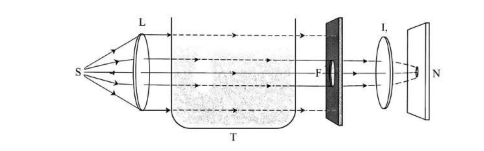
Q. Why does the Sun appear reddish in the morning? Draw the ray diagram of the apparatus used to observe the scattering of light in a colloidal solution. HSLC ’19
Ans: In the morning, the Sun is near the horizon (very far away). Except for red light, other components of sunlight have shorter wavelengths and get scattered or absorbed while passing through the atmosphere. Only the red light, having the longest wavelength, reaches the observer. Hence, the Sun appears reddish.
Multiple Choice Questions (MCQ)
Q. Which of the following has the maximum wavelength of light?
(a) Blue
(b) Orange
(c) Violet
(d) Red
Ans: (d) Red
Q. The colour of the sky is blue due to ______ of light.
(a) Scattering
(b) Dispersion
(c) Reflection
(d) None of these
Ans: (a) Scattering
Q. The difference between advanced sunrise and actual sunrise is:
(a) 3 minutes
(b) 2 minutes
(c) 4 minutes
(d) 1 minute
Ans: (b) 2 minutes
Q. The part located behind the cornea of the eye is:
(a) Pupil
(b) Retina
(c) Ciliary muscles
(d) Iris
Ans: (d) Iris
Q. The image in the eye is formed on:
(a) Cornea
(b) Iris
(c) Ciliary muscles
(d) Retina
Ans: (d) Retina
Q. Due to the action of which part does the focal length of the eye lens change?
(a) Pupil
(b) Retina
(c) Ciliary muscles
(d) Iris
Ans: (c) Ciliary muscles
Q. The least distance of distinct vision for a normal adult is:
(a) 25 m
(b) 2.5 cm
(c) 25 cm
(d) 2.5 m
Ans: (c) 25 cm
Q. The ability of the human eye to adjust the focal length of its lens to focus on objects at different distances is due to:
(a) Presbyopia
(b) Power of accommodation
(c) Myopia
(d) Hypermetropia
Ans: (b) Power of accommodation
Q. The coloured components of a beam of light are called:
(a) Band
(b) Dispersion
(c) Scattering
(d) Spectrum
Ans: (d) Spectrum
Q. Which scientist first used a prism to obtain the spectrum of light?
(a) Newton
(b) Galileo
(c) Einstein
(d) Rutherford
Ans: (a) Sir Isaac Newton
Q. The formation of a rainbow due to tiny water droplets in the atmosphere is caused by:
(a) Scattering
(b) Dispersion
(c) Reflection
(d) None of these
Ans: (b) Dispersion
Q. A rainbow is formed:
(a) In the same direction as the Sun
(b) In the opposite direction of the Sun
(c) Independent of the Sun’s direction
(d) None of these
Ans: (b) In the opposite direction of the Sun

