

Class 10 Science Chapter 13 Magnetic Effects of Electric Current
Are you looking for Class 10 Science Chapter 13 Magnetic Effects of Electric Current notes and question answers? If yes, you are in the right place. This chapter explains how electric current and magnetism are connected. It is one of the most important chapters in Class 10 Science and is very useful for school exams, HSLC board exams, and competitive examinations.
In this chapter, you will learn how an electric current produces a magnetic field and how this principle is used in many electrical devices. Important topics include magnetic field lines, the magnetic field around a current-carrying conductor, Fleming’s Left-Hand Rule, the electric motor, electromagnetic induction, Fleming’s Right-Hand Rule, the electric generator, and domestic electric circuits. These concepts help students understand the working of many machines and appliances used in everyday life.
The notes and question answers are written in easy and simple English, making them easy to understand for every student. Each topic is explained step by step with clear answers, helping students learn quickly and revise effectively before examinations.
Whether you are preparing for class tests, annual examinations, or the HSLC Board Examination, these notes and solutions will help you understand the chapter better, improve your confidence, and score higher marks in Science.
✨ What You Will Get:
- 📘 Easy Chapter Notes
- ❓ Complete Textbook Question Answers
- ⭐ Important Exam Questions
- 📝 Simple and Easy Explanations
- 📚 Quick Revision Notes
- 🎯 HSLC Board Exam Preparation
Start studying Class 10 Science Chapter 13, Magnetic Effects of Electric Current, today and make your Science preparation simple, effective, and exam-ready.
Magnetic Effects of Electric Current
Selected Questions &Answers
1. Q. Write the names of some sources of direct current.
Ans: Dry cell, car battery, solar cell, etc.
Q. Which sources produce alternating current?
Ans: Hydroelectric generators, thermal power plants, nuclear power generators, etc.
Q. What is the function of the split ring in an electric motor?
Ans: The split ring reverses the direction of current in the coil after every half rotation. As a result, the coil continues to rotate in the same direction.
Q. What is the basic principle of an electric generator? HSLC ’20
Ans: A conductor is rotated in a magnetic field by applying mechanical energy, which is then converted into electrical energy.
Q. Write the names of two safety devices commonly used in electrical circuits and appliances.
Ans: Electric fuse and earthing.
Q. Mention two methods of producing a magnetic field.
Ans: (a) A magnetic field can be produced by a current-carrying conductor.
(b) A magnetic field can be produced by passing current through a solenoid.
Q. When does a current-carrying conductor placed in a magnetic field experience maximum force?
Ans: When the direction of current is perpendicular to the direction of the magnetic field.
Q. Write the names of some devices in which electric motors are used.
Ans: Electric fan, washing machine, cooler, etc.
Q. Why does the needle of a compass deflect when brought near a bar magnet?
Ans: We know that like poles of a magnet repel each other and unlike poles attract each other. When a compass is brought near a bar magnet, the magnetic needle experiences repulsion from like poles and attraction from unlike poles, resulting in deflection.
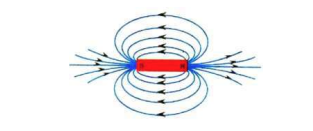
Q. Draw the magnetic field lines around a bar magnet.
Ans:
Q. List the properties of magnetic field lines.
Ans: (i) Magnetic field lines emerge from the north pole and enter the south pole.
(ii) Inside the magnet, the direction of the field lines is from the south pole to the north pole. Therefore, the field lines form continuous closed loops.
(iii) Magnetic field lines have no real (physical) existence.
(iv) Two magnetic field lines never intersect each other.
Q. Consider a circular coil of wire placed on the plane of a table. Suppose current is flowing through it in the clockwise direction. Using theright-hand rule, determine the direction of the magnetic field inside and outside the coil.
Ans:
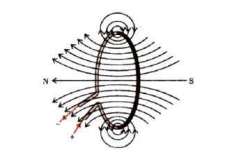
The face of the coil towards the observer (front side) will act as the south pole, and the part touching the table will indicate the north pole. According to the right-hand rule, the direction of the magnetic field inside the coil will be downward, and outside the coil, the direction of the magnetic field will be upward.
Q. The magnetic field in a given region is uniform. Draw a diagram to represent it.
Ans: In a uniform magnetic field, the magnetic field lines are parallel straight lines and are equally spaced from one another.
────────────────────→
S ────────────────────→ N
────────────────────→
────────────────────→
Q. Choose the correct answer.
The magnetic field inside a current-carrying long solenoid is:
(a) Zero
(b) Decreases gradually towards its ends
(c) Increases gradually towards its ends
(d) Same at all points
Ans: (d) Same at all points.
Q. Which of the following properties of a proton moving freely in a magnetic field may change? (There may be more than one correct answer)
(a) Energy
(b) Speed
(c) Velocity
(d) Momentum
Ans: (c) Velocity and (d) Momentum.
Q. State Fleming’s Left-Hand Rule.
Ans: Fleming’s Left-Hand Rule states that if the thumb, forefinger, and middle finger of the left hand are stretched mutually perpendicular to each other, and if the forefinger and middle finger represent the direction of the magnetic field and electric current respectively, then the thumb indicates the direction of the force acting on the conductor.
Q. What is the principle of an electric motor? HSLC ’18
Ans: The principle of an electric motor is that a current-carrying conductor placed in a magnetic field experiences a force, thereby converting electrical energy into mechanical energy.
Q. What is the role of the split ring in an electric motor?
Ans: In an electric motor, the split ring helps to reverse the direction of current in the coil after every half rotation. As a result, the coil continues to rotate in the same direction.
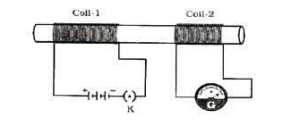
Q. Explain the different ways of inducing current in a coil.
Ans: Current can be induced in a coil by moving a bar magnet towards and away from a wire. A change in the magnetic field linked with a nearby coil also induces a current in another coil. This can be demonstrated with the help of diagrams.
Q. Write the names of some sources of direct current.
Ans: Dry cell, car battery, solar cell, etc.
Q. An instrument that produces electric current is called:
(a) Generator
(b) Galvanometer
(c) Ammeter
(d) Motor
Ans: (a) Generator.
Q. The essential difference between an alternating current generator and a direct current generator is— HSLC ’17
(a) An AC generator has an electromagnet, whereas a DC generator has a permanent magnet.
(b) A DC generator produces a high potential difference.
(c) An AC generator produces a high potential difference.
(d) An AC generator has slip rings, whereas a DC generator has a commutator.
Ans: (d) An AC generator has slip rings, whereas a DC generator has a commutator.
Q. During a short circuit, the current in the circuit:
(a) Decreases considerably
(b) Remains unchanged
(c) Increases considerably
(d) Changes continuously
Ans: (c) Increases considerably.
Q. State whether the following statements are true or false:
(a) An electric motor converts mechanical energy into electrical energy.
(b) An electric generator works on the principle of electromagnetic induction.
(c) The magnetic field at the center of a circular current-carrying conductor is in the form of parallel straight lines.
(d) The green insulated wire is usually the live wire of the electric supply.
Ans:
(a) False
(b) True,
(c) True,
(d) False.
Q. Mention two methods of producing a magnetic field.
Ans: (a) A magnetic field can be produced by a current-carrying conductor.
(b) A magnetic field can be produced by passing current through a solenoid.
Q. Why does a solenoid behave like a magnet? Can you determine the north and south poles of a current-carrying solenoid with the help of a bar magnet? Explain. HSLC ’17
Ans: A current-carrying coil behaves like a magnet, having a north pole at one end and a south pole at the other end. If such a coil is suspended freely, one end points towards the north and the other towards the south.
The north and south poles of a current-carrying solenoid can be identified with the help of a bar magnet. If the north pole of a magnet is brought near one end of the solenoid and attraction occurs, then that end of the solenoid is the south pole. If repulsion occurs, then that end is the north pole.
Q. Draw a labelled diagram of an electric motor. Explain its principle and working. What is the function of the split ring in an electric motor?HSLC ’19
Ans:
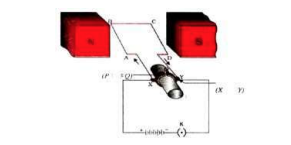
The principle of an electric motor is that a current-carrying conductor placed in a magnetic field experiences a force, thereby converting electrical energy into mechanical energy.
Working: When current flows through the coil placed in a magnetic field, forces act on the two sides of the coil in opposite directions, causing the coil to rotate. After every half rotation, the split ring reverses the direction of current, so the coil continues to rotate in the same direction.
The split ring in an electric motor acts as a commutator. It reverses the direction of current in the coil after every half rotation, maintaining continuous rotation.
Q. With the help of a labelled diagram, describe the principle and working of an electric generator. What is the function of the two brushes? HSLC’20
Ans:
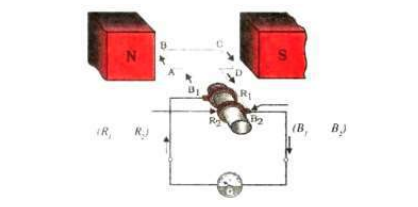
Principle: An electric generator converts mechanical energy into electrical energy. It works on the principle of electromagnetic induction.
Working: A coil ABCD is rotated in a magnetic field such that the rings R1and R2 also rotate with it. The arm AB moves upward while CD moves downward. This motion induces a current in them, which flows in the external circuit in the direction ABCD. After half a rotation, ring R1 comes in contact with brush B2 and arm CD moves upward, while ring R2 comes in contact with brush B1 and arm AB moves downward. As a result, the induced current changes direction and flows as DCBA. Due to this continuous process, the direction of current changes periodically, producing alternating current. The brushes help in collecting the current from the rotating rings and transferring it to the external circuit.
Q. What is an armature?
Ans: In a commercial motor, the iron core and the coil together are called the armature.
Q. When is the induced current in a coil maximum?
Ans: The induced current is maximum when the direction of motion of the coil is perpendicular to the magnetic field.
Q. Write some uses of an electric motor.
Ans: Electric motors are used in electric fans, washing machines, computers, MP3 players, etc.
Q. Choose the correct answer: HSLC ’17
The magnetic field inside a current-carrying long solenoid is:
(a) Increases towards the ends
(b) Decreases towards the ends
(c) Zero
(d) Same at all points
Ans: (d) Same at all points.
Q. What is a magnet?
Ans: A magnet is a substance that possesses both attractive and repulsive forces.
Q. What is an electromagnet?
Ans: When certain magnetic materials like soft iron are placed inside a solenoid carrying current, they become magnetized due to the strong magnetic field produced. Such a magnet is called an electromagnet.
Q. Is it possible to obtain an isolated magnetic pole?
Ans: No, it is not possible to obtain an isolated magnetic pole.
Q. What is the nature of the magnetic field inside a solenoid?
Ans: Inside a solenoid, the magnetic field lines are straight and parallel to the axis of the solenoid. The magnitude of the magnetic field is the same at every point inside it.
Q. What is a galvanometer?
Ans: A galvanometer is an instrument used to detect the presence of current in a circuit.
Q. What are the poles of a magnet?
Ans: The two regions at the ends of a magnet where the attractive and repulsive forces are strongest are called the poles of the magnet.
Q. Why can two magnetic field lines never intersect each other?
Ans: The tangent drawn at any point on a magnetic field line gives the direction of the magnetic field at that point. If two field lines intersected, there would be two tangents at that point, meaning the magnetic field would have two directions simultaneously, which is not possible. Therefore, two magnetic field lines never intersect.
Q. What is electromagnetic induction?
Ans: Electromagnetic induction is the process of producing an induced current in a coil due to the relative motion between a magnet and the coil.
Q. How many types of electric generators are there, and what are they?
Ans: There are two types of electric generators:
(a) Alternating current generator: This type produces alternating current.
(b) Direct current generator: This type produces direct current.
Q. Mention two safety measures commonly used in electrical circuits and appliances.
Ans: Two common safety measures are:
(a) Fuse
(b) Earthing wire.
Multiple Choice Questions (MCQ)
Q. The instrument used to detect the presence of electric current is—
(a) Voltmeter
(b) Ammeter
(c) Galvanometer
(d) Barometer
Ans: (c) Galvanometer.
Q. A rectangular coil of copper wire is rotated in a magnetic field. The direction of the induced current will change—
(a) After two rotations
(b) After one rotation
(c) After half a rotation
(d) After one-fourth rotation
Ans: (c) After half rotation.
Q. Which of the following correctly describes the magnetic field near along, straight conductor?
(a) The field consists of straight lines perpendicular to the wire
(b) The field consists of straight lines parallel to the wire
(c) The field consists of radial lines emerging from the wire
(d) The field consists of concentric circles centered on the wire
Ans: (d) The field consists of concentric circles centered on the wire.
Q. Electromagnetic induction is—
(a) The process of charging a body
(b) The process by which a current-carrying coil produces a magnetic field
(c) The process of inducing current in a coil due to relative motion between a magnet and the coil
(d) The process of rotation of the coil in an electric motor
Ans: (c) The process of inducing current in a coil due to relative motion between a magnet and the coil.
Q. An instrument that produces electric current is—
(a) Generator
(b) Galvanometer
(c) Ammeter
(d) Motor
Ans: (a) Generator.
Q. An electron enters a magnetic field perpendicularly. The direction of the force acting on it will be—
(a) Towards right
(b) Towards left
(c) Out of the plane
(d) Into the plane
Ans: (d) Into the plane.
Q. The direction of magnetic field lines outside a solenoid is—
(a) From north pole to south pole
(b) From north pole to center
(c) From south pole to north pole
(d) From center to south pole
Ans: (a) From north pole to south pole.
Q. A positively charged particle (alpha particle) projected towards the west is deflected towards the north in a magnetic field. The direction of the magnetic field is—
(a) Southward
(b) Eastward
(c) Downward
(d) Upward
Ans: (d) Upward.
Q. During a short circuit, the current in the circuit—
(a) Decreases considerably
(b) Does not change
(c) Changes continuously
(d) Increases considerably
Ans: (d) Increases considerably.

