

Class 10 Science Chapter 7 Control and Coordination
Are you looking for the best study material for Class 10 Science Chapter 7 Control and Coordination? You’re in the right place! This chapter is one of the most important topics in Class 10 Biology and explains how living organisms control, coordinate, and respond to different activities and environmental changes. Here, you will find easy notes, complete textbook question answers, important questions, and exam-oriented study materials to help you prepare with confidence.
In this chapter, you will learn about the human nervous system, neurons, reflex actions, brain and spinal cord, coordination in plants, plant hormones, and animal hormones (endocrine system). The chapter also explains how plants respond to external stimuli and how hormones regulate growth, development, and various body functions. These concepts are essential for understanding how living organisms maintain proper coordination and balance.
The study material is prepared in simple, clear, and student-friendly English, making it easy for every student to understand complex biological concepts. It is ideal for concept building, quick revision, and effective exam preparation.
Whether you are preparing for class tests, annual examinations, or the HSLC Board Examination, this chapter will help you strengthen your Biology concepts, improve your understanding, and score higher marks in Science.
✨ What You’ll Get:
- 📘 Easy & Simple Chapter Notes
- ❓ Complete Textbook Question Answers
- ⭐ Important Exam-Oriented Questions
- 📝 Quick Revision Notes
- 🎯 HSLC Board Exam Preparation
- 💡 Simple Explanations for Better Understanding
Master Class 10 Science Chapter 7 Control and Coordination with well-organized study materials and boost your confidence for every examination.
Class 10 Science Chapter 7 Control and Coordination
Selected Questions &Answers
Q. What is the peripheral nervous system?
Ans: The nervous system that establishes a connection between the central nervous system and various parts of the body is called the peripheral nervous system.
Q. Write two functions of the brain.
Ans: (a) The brain helps us to think.
(b) The brain maintains the balance of the body.
Q. What is the name of the part of the brain that controls body movement and balance? HSLC ’19
Ans: Cerebellum.
Q. What are the two types of peripheral nerves? HSLC ’17
Ans: Axon and dendrite.
Q. What are the nerves that originate from the brain called?
Ans: Cranial nerves.
Q. Which part of the brain takes part in maintaining body movement and balance?
Ans: The part called the cerebellum, located in the hindbrain.
Q. Write two functions of the forebrain.
Ans: (a) The forebrain plays a major role in thinking.
(b) It receives nerve impulses from hearing, smell, sight, etc.
Q. Which part of the brain controls involuntary actions?
Ans: The midbrain and hindbrain.
Q. What is the role of the brain in reflex action?
Ans: Reflex action occurs in the spinal cord. The brain provides the necessary information for reflex action.
Q. Write two differences between axon and dendrite. HSLC ’19
Ans: The two differences between axon and dendrite are:
(a) The axon transmits nerve impulses from the nerve cell to the adjacent nerve cell. On the other hand, dendrites receive stimuli from adjacent nerve cells.
(b) Axons are generally long, whereas dendrites are generally short.
Q. How many types of movements are found in plants and what are they?
Ans: There are two types of movements in plants, namely growth movement and independent movement.
Q. Through what medium do plants maintain connection between one cell and another?
Ans: Through an electrochemical medium.
Q. What is the difference between reflex action and walking?
Ans: (a) Reflex action is spontaneous and rapid. It occurs involuntarily.
On the other hand, walking is not spontaneous; it occurs due to signals sent by nerves to the leg muscles.
(b) Reflex action is controlled by the spinal cord. On the other hand, walking is controlled by the hind part of the brain.
(c) Reflex action is an involuntary action, whereas walking is a voluntary action.
Q. What are plant hormones?
Ans: Plant hormones are chemical compounds that help in growth and development and respond to environmental stimuli. Some plant hormones are auxin, gibberellin, cytokinin, and abscisic acid.
Q. What is the difference between the movement of Mimosa leaves and the movement of the tip of a stem towards light?
Ans: The leaves of Mimosa respond to external stimuli, so they fold immediately when touched. But the tip of the stem moves towards light, and this movement is very slow.
Q. Name a plant hormone that helps in plant growth. HSLC ’20
Ans: Auxin.
Q. How does auxin help in the growth of a tendril around a support?HSLC ’20
Ans: Auxin helps plant cells to enlarge and elongate. When the tendril comes in contact with a support, the concentration of auxin increases on the side not in contact with the support. As a result, that side grows longer, helping the tendril to coil around the support.
Q. What is an endocrine gland? What is the difference between an endocrine gland and an exocrine gland? Name the gland that performs both functions. HSLC ’18
Ans: An endocrine gland is a gland that directly secretes hormones into the bloodstream and helps in control and coordination.
Exocrine glands do not secrete directly into the bloodstream.
The gland that performs both endocrine and exocrine functions is the pancreas.
Q. Write the functions of adrenaline hormone. HSLC ’17
Ans: The functions of adrenaline hormone are:
(a) It increases heartbeat and supplies more oxygen to muscles.
(b) It increases blood flow to skeletal muscles.
(c) It increases the rate of breathing by causing contraction of the diaphragm and rib muscles.
Q. What is the name of the part of the brain responsible for maintaining balance and posture? HSLC ’16
Ans: Cerebellum.
Q. Which plant hormone stimulates cell division? HSLC ’15
Ans: Cytokinin.
Q. Which hormone causes the falling of leaves in plants? HSLC ’17
Ans: Abscisic acid.
Q. Prepare an experimental setup to demonstrate hydrotropism.
Ans:
Experiment: A pot is taken and filled with sand. Some seeds are planted in it. A container filled with water and having a small opening is placed inside the pot. The setup is left for about a week.
Observation: After a week, when the seeds are taken out, it is observed that new roots have grown towards the direction of water. This experiment
demonstrates hydrotropism.
Q. How does chemical coordination occur in animals?
Ans: In vertebrates, the endocrine system controls and coordinates the functions of different organs and their activities. It regulates various metabolic activities of the body. Its ductless glands secrete chemical hormones,
which directly enter the bloodstream and are transported to specific organs. In this way, they control chemical coordination among different organs.
Q. Why is it necessary to consume iodised salt? HSLC ’20
Ans: It is necessary to consume iodised salt due to the following reasons:
(i) Iodine is essential for the synthesis of thyroxine hormone secreted by the thyroid gland.
(ii) Due to lack of iodine, goitre may occur in our body.
Q. Why are some diabetic patients given insulin injections?
Ans: In diabetic patients, the amount of insulin in the body decreases. Insulin reduces the level of glucose in the blood. Therefore, insulin injections are given to diabetic patients.
Q. What is the function of receptor organs in our body? What may happen if they do not function properly? What problems may arise?
Ans: Receptor organs are specialized cells or groups of cells that detect changes in the external environment and send these signals to the brain. If receptor organs do not function properly, our life may become risky. For example, we may not be able to distinguish between different types of food such as salty or sour, and we may consume harmful food, which can lead to diseases.
Q. Draw a diagram of a neuron. Describe its function.
Ans:
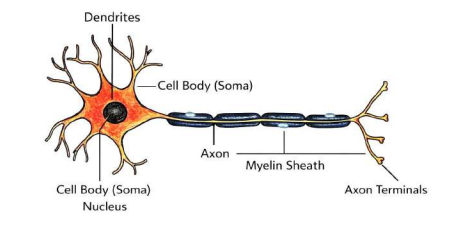
The nerve impulses of the body can be transmitted over long distances in a very short time. They carry messages through electrical signals. The axon performs the functions of insulation and protection. Dendrites receive nerve impulses or stimuli from nearby nerve cells.
Q. What kind of messages are affected if the spinal cord is injured?
Ans: If the spinal cord is injured, reflex actions and involuntary functions are affected.
Q. How can you differentiate between voluntary action and reflex action?
Ans: The differences between voluntary action and reflex action are:
(a) Voluntary action is controlled by the medulla located in the hindbrain. On the other hand, reflex action is controlled by the spinal cord.
(b) In voluntary action, the response to a stimulus is slow. On the other hand, in reflex action, the response to a stimulus is very fast.
(c) Voluntary action is not sensitive to external stimuli, whereas reflex action is sensitive to external stimuli.
Q. Which hormone causes the falling of leaves in plants?
Ans: Abscisic acid.
Q. Which part of the brain controls involuntary functions?
Ans: The medulla located in the hindbrain.
Q. Where is the insulin hormone produced in the human body?
Ans: In the pancreas.
Q. What are nerve cells made up of?
Ans: Nerve cells are made up of a cell body and nerve processes.
Q. Into how many parts are nerve processes divided? HSLC ’15
Ans: Axon and dendrite.
Q. What is reflex action? Give two examples.
Ans: Reflex action is the spontaneous, rapid, and involuntary response of the body to a stimulus.
Examples:
(a) Immediately withdrawing the hand when it touches a hot object.
(b) Closing the eyes instantly when exposed to bright light.
Q. Name the hormone that helps in fruit ripening.
Ans: Ethylene.
Q. Write the functions of gibberellin.
Ans: The functions of gibberellin are-
(a) Helps in the germination of seeds in some plants.
(b) Makes dwarf plants grow taller.
(c) Helps in the growth of the stem.
(d) Promotes the flowering of dormant buds in some plants.
Q. What is hydrotropism? Demonstrate hydrotropism with the help of an experiment. HSLC ’19
Ans: Hydrotropism is the movement of plants in response to the presence or source of water.
To demonstrate hydrotropism, we can perform the following experiment.
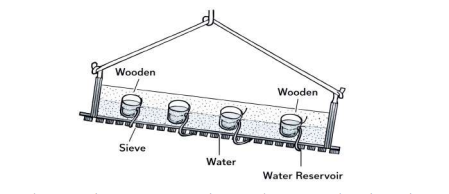
For the experiment, some moist sawdust was taken in a sieve, and a few-gram seeds were placed in it. After a few days, it was observed that the seeds had germinated and the radicles from each seed had emerged out through the pores of the sieve. This happens because the roots are positively geotropic.
Later, the emerged radicles bend towards water and re-enter the moist sawdust through the pores of the sieve. This experiment proves that the movement of roots is hydrotropic.
Q. What is a hormone? Give one example of a hormone (plant growth regulator) involved in plant growth. Is there any difference between the movement of leaves of a sensitive plant and the movement of the stem towards light? HSLC ’19
Ans: Plant hormones (growth regulators) are chemical compounds that promote growth and development in plants and respond to environmental stimuli. Some plant hormones are auxin, gibberellin, cytokinin, and abscisic acid.
The movement of the leaves of a sensitive plant depends on the direction of the stimulus. On the other hand, the stem moves towards the direction of light. In this process, oxygen plays a role.
Multiple Choice Questions (MCQ)
Q. Which of the following is a plant hormone?
(a) Insulin
(b) Thyroxine
(c) Oestrogen
(d) Cytokinin
Ans: (d) Cytokinin.
Q. What is the gap between two neurons called?
(a) Dendrite
(b) Synapse
(c) Axon
(d) Impulse
Ans: (b) Synapse.
Q. What does the brain do?
(a) Thinking and reasoning
(b) Controls heartbeat
(c) Maintains body balance
(d) All of the above
Ans: (d) All of the above.
Q. The connecting pathway between two neurons is called—
(a) Dendrite
(b) Axon
(c) Synapse
(d) Myelin sheath
Ans: (c) Synapse.
Q. Name the two types of nerve processes.
(a) Axon and dendrite
(b) Axon and hydrite
(c) Axon and thymus
(d) None of the above
Ans: (a) Axon and dendrite.
Q. Reflex action is controlled by—
(a) Cerebellum
(b) Hindbrain
(c) Spinal cord
(d) None of the above
Ans: (c) Spinal cord.
Q. The part of the brain responsible for maintaining body balance and posture is—
(a) Cerebellum
(b) Medulla
(c) Pons
(d) Cerebrum
Ans: (a) Cerebellum.
Q. The movement of plant roots is called—
(a) Phototropism
(b) Chemotropism
(c) Geotropism
(d) None of the above
Ans: (c) Geotropism.
Q. Which of the following is not a plant hormone?
(a) Gibberellin
(b) Testosterone
(c) Auxin
(d) Cytokinin
Ans: (b) Testosterone.
Q. Which hormone inhibits plant growth?
(a) Gibberellin
(b) Cytokinin
(c) Auxin
(d) Abscisic acid
Ans: (d) Abscisic acid.
Q. Which hormone causes the falling of leaves?
(a) Auxin
(b) Gibberellin
(c) Abscisic acid
(d) Cytokinin
Ans: (c) Abscisic acid.
Q. Activities like cycling and holding a pencil are controlled by—
(a) Midbrain
(b) Cerebellum
(c) Forebrain
(d) Spinal cord
Ans: (b) Cerebellum.
Q. The movement of the pollen tube towards the ovule in plants is an example of—
(a) Phototropism
(b) Chemotropism
(c) Hydrotropism
(d) None of the above
Ans: (b) Chemotropism.
Q. Which part of the brain helps in body movement and maintaining balance?
(a) Midbrain
(b) Spinal cord
(c) Forebrain
(d) Cerebellum
Ans: (d) Cerebellum.
Q. The hormone that stimulates cell division is—
(a) Auxin
(b) Cytokinin
(c) Abscisic acid
(d) Gibberellin
Ans: (b) Cytokinin.
Q. Which disease is caused due to insufficient secretion of thyroxine hormone?
(a) Beriberi
(b) Goitre
(c) Diabetes
(d) Rickets
Ans: (b) Goitre.
Q. The hormone produced by the pancreas that helps regulate blood sugar level is—
(a) Adrenaline
(b) Thyroxine
(c) Insulin
(d) Testosterone
Ans: (c) Insulin.

