

Class 9 Science Chapter 9 Force and Laws of Motion
If you are a Class IX student searching for high-quality SEBA Class 9 Science Chapter 9 Force and Laws of Motion notes to improve your exam performance, then this Ready Guide is for you. It includes all the important question-answers prepared by a team of experts. Our language is very easy to understand and remember. Begin your study journey with us for a bright future.
CForce and Laws of Motion
Answers to Questions Within the Lesson(1)
1. Among the following, which object has greater inertia?
(a) A rubber ball and a stone ball of the same size?
(b) A bicycle and a train?
(c) A five-rupee coin and a one-rupee coin?
Ans: (a) Compared to a rubber ball, a stone ball of the same size has more mass. Therefore, the stone ball has greater inertia.
(b) A train has more mass than a bicycle. Therefore, the train has greater inertia.
(c) A five-rupee coin has more mass than a one-rupee coin. Therefore, the five-rupee coin has greater inertia.
2. In the example given below, try to identify how many times the velocity of the ball changes:
A football player passes the ball to another player on his team, who then kicks the ball towards the goal. The goalkeeper of the opposing team catches the ball and passes it to another player on his own team. In each case, identify the agent supplying the force.
Ans: In the situation described, the motion of the football changes four times. In the first and second cases, the players apply force on the ball with their feet. In the third case, the goalkeeper applies force with his hands to stop the ball. In the fourth case, the goalkeeper kicks the ball with his foot, thus applying force.
3. Why do some leaves fall when a branch of a tree is shaken vigorously?
Ans: Due to the inertia of rest, the leaves attached to the tree tend to remain in their state of rest. But when the branch is shaken, it gains motion. As a result, the leaves fall off.
4. Why do we fall forward when a moving bus stops suddenly, and fall backward when a stationary bus starts suddenly?
Ans: While a bus is moving, our body remains in a state of rest relative to the seat. When the bus stops suddenly, the bus comes to rest but our body tends to remain in motion due to the inertia of motion. As a result, we fall forward.
Similarly, when a bus is at rest, our body is also at rest. When the bus suddenly starts moving, the part of our body in contact with the bus (feet)begins to move, but the rest of the body resists this change due to inertia. As a result, we fall backward.
Answers to Questions Within the Lesson(2)
1. If action is always equal to reaction, then explain how a horse can pull a cart.
Ans: When a horse pulls a cart with a force, the cart also pulls the horse with an equal and opposite force. However, the horse also applies force on the ground with its feet. The ground, in turn, exerts an equal and opposite reaction force, which pushes the horse (and hence the cart) forward.
2. Explain why a fire brigade worker finds it difficult to hold the end of a hose pipe through which water is coming out at high speed.
Ans: When water is not flowing through the pipe, its momentum is zero. When a fire brigade worker allows water to flow at high speed, the water gains momentum in the forward direction. Due to the reaction force (opposite change in momentum), the pipe tends to move backward, making it difficult to hold.
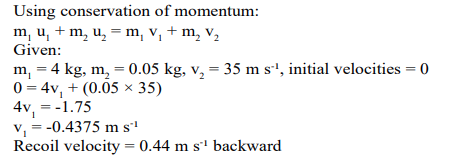
Q3. A gun of mass 4 kg fires a bullet of mass 50 g with an initial velocity of 35 m s-¹. What is the initial recoil velocity of the gun?
Ans:
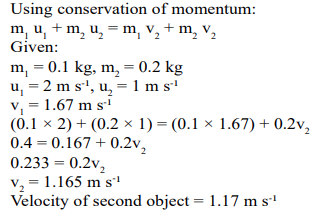
Q4. Two objects of masses 100 g and 200 g are moving along the same straight line in the same direction with velocities 2 m s-¹ and 1 m s-¹ respectively. They collide, and after collision the velocity of the first object becomes 1.67 m s-¹. Find the velocity of the second object.
Ans:
 Exercise: Questions and Answers
Q1. A body is not subjected to any external unbalanced force. Is it possible for the body to move with some velocity? If yes, state the conditions on the magnitude and direction of the velocity. If not, explain why.
Ans: Yes, it is possible. According to Newton’s First Law of Motion, if no external force acts on a body, it can either remain at rest or continue to move with constant velocity. Therefore, the velocity must remain constant in both magnitude and direction (i.e., uniform velocity in a straight line).
Q2. When a carpet is beaten with a stick, dust particles come out. Explain.
Ans: Before beating, both the carpet and dust particles are at rest due to inertia. When the carpet is struck, it moves suddenly, but the dust particles tend to remain at rest due to the principle of inertia. As a result, the dust gets separated and falls off.
Q3. Why are objects kept on the roof of a bus tied with a rope?
Ans: When the bus is at rest, the objects remain at rest due to inertia. When the bus suddenly starts moving, the objects tend to remain in their state of rest and may fall backward. To prevent this, they are tied with a rope.
Q4. A cricket ball hit by a batsman rolls on the ground for some distance and then stops. The reason is:
(a) The batsman did not hit the ball hard enough
(b) The velocity of the ball is proportional to the force applied on it
(c) A force opposing the motion of the ball is acting on it
(d) No unbalanced force is acting on the ball, so it stops
Ans: (c) A force opposing the motion of the ball is acting on it (friction).
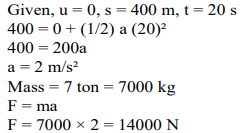
Q5. A truck starts from rest and moves down a hill with uniform acceleration. It covers a distance of 400 m in 20 s. Find its acceleration. If the mass of the truck is 7 metric tons, find the force acting on it. (Given: 1 ton= 1000 kg)
s = ut + 1/2at²
Ans:
Q6. A 1 kg stone is thrown across the surface of a frozen lake with a speed of 20 m/s. It comes to rest after covering 50 m. Find the frictional force between the stone and the ice.
v²= u²+ 2as
Ans:
Given, u = 20 m/s, v = 0, s = 50 m
0 = (20)² + 2a(50)
0 = 400 + 100a
a = -4 m/s²
Frictional force, F = ma = 1 × (-4) = -4 N
Magnitude = 4 N
Q7. An engine of mass 8000 kg pulls 5 wagons, each of mass 2000 kg, along a horizontal track. The engine exerts a force of 40000 N and friction is 5000 N. Find:
(a) Net accelerating force
(b) Acceleration of the train
(c) Force exerted by the 1st wagon on the 2nd wagon
F ₙₑₜ = F – f
Ans:
(a) Net force = 40000 – 5000 = 35000 N
Total mass = 8000 + (5 × 2000) = 18000 kg
a = F/m
(b) a = 35000 / 18000 ≈1.94 m/s²
Mass of last 4 wagons = 4 × 2000 = 8000 kg
(c) Force = 8000 × 1.94 ≈ 15520 N
Q8. A motor car of mass 1500 kg is to be stopped with a negative acceleration of 1.7 m/s². Find the force between the car and the road.
F = ma
Ans:
F = 1500 × (-1.7) = -2550 N
Magnitude of force = 2550 N
Q9. If a body of mass m moves with velocity v, its momentum will be:
(a) (mv)²
(b) mv²
(c) 1/2 mv²
(d) mv
Ans: (d) mv
Q10. A wooden box is pushed along a floor with a horizontal force of 200 N, and it moves with constant velocity. What is the frictional force exerted by the floor on the box?
Ans: Since the box moves with constant velocity, the net force is zero. Therefore, the frictional force is equal in magnitude and opposite in direction to the applied force.
Frictional force = 200 N
Q11. Two bodies of mass 1.5 kg each are moving along the same straight line in opposite directions with speeds of 2.5 m/s before collision. After a collision, they stick together. Find their velocity after collision.
Ans:
Initial momentum = (1.5 × 2.5) + (1.5 × -2.5) = 3.75 – 3.75 = 0
After collision, combined mass = 1.5 + 1.5 = 3 kg
Velocity after collision = Total momentum / Total mass = 0 / 3 = 0 m/s
Q12. According to the third law of motion, if we push an object, the object pushes us back with an equal and opposite force. If the object is a heavy truck parked on the roadside, it is unlikely to move. A student argues that equal and opposite forces balance each other, so the truck should not move. Give your opinion and explain why the truck does not move.
Ans: The student’s argument is incorrect. According to Newton’s Third Law of Motion, action and reaction forces are equal and opposite but they act on different bodies, so they do not cancel each other.
When we push the truck, it exerts an equal and opposite force on us, but this does not affect the truck’s motion directly. The main reason the truck does not move is its large mass (inertia) and the presence of friction between the truck’s tyres and the ground. The applied force is not sufficient to overcome this friction and inertia, so the truck remains at rest.
Q13. A hockey ball of mass 200 g is moving with a velocity of 10 m/s. It is struck by a hockey stick and returns along the same path with a velocity of 5 m/s. Find the change in momentum of the ball due to the force applied by the stick.
Ans:
Mass = 200 g = 0.2 kg
Initial velocity, u = 10 m/s
Final velocity, v = -5 m/s (opposite direction)
Initial momentum = 0.2 × 10 = 2 kg·m/s
Final momentum = 0.2 × (-5) = -1 kg·m/s
Change in momentum = Final – Initial
= -1 – 2 = -3 kg·m/s
Magnitude of change in momentum = 3 kg·m/s
Q14. A bullet of mass 10 g moving horizontally with a velocity of 150m/s strikes a stationary wooden block and comes to rest in 0.03 s. Find the distance penetrated by the bullet into the block. Also find the force exerted by the block on the bullet.
Ans:
Mass = 10 g = 0.01 kg
Initial velocity, u = 150 m/s
Final velocity, v = 0
Time, t = 0.03 s
Acceleration:
a = (v – u) / t = (0 – 150) / 0.03 = -5000 m/s²
Distance penetrated:
s = ut + (1/2)at²
= (150 × 0.03) + (1/2)(-5000)(0.03)²
= 4.5 – 2.25
= 2.25 m
Force exerted:
F = ma = 0.01 × (-5000) = -50 N
Magnitude of force = 50 N
Q15. A body of mass 1 kg moving along a straight line with a velocity of 10 m/s collides with a stationary wooden block of mass 5 kg and sticks to it. After collision, both move together along the same straight line. Find the total momentum just before and just after collision. Also find the velocity of the combined body.
Ans:
Before collision:
Momentum = (1 × 10) + (5 × 0) = 10 kg·m/s
After collision:
Total mass = 1 + 5 = 6 kg
Using conservation of momentum:
Final momentum = Initial momentum = 10 kg·m/s
Velocity of combined body:
v = Total momentum / Total mass = 10 / 6 ≈1.67 m/s
Q16. A body of mass 100 kg is uniformly accelerated from a velocity of 5 m/s to 8 m/s in 6 s. Find its initial and final momentum. Also find the force applied on the body.
Ans:
Mass, m = 100 kg
Initial velocity, u = 5 m/s
Final velocity, v = 8 m/s
Time, t = 6 s
Initial momentum = m × u = 100 × 5 = 500 kg·m/s
Final momentum = m × v = 100 × 8 = 800 kg·m/s
Acceleration:
a = (v – u) / t = (8 – 5) / 6 = 0.5 m/s²
Force applied:
F = m × a = 100 × 0.5 = 50 N
Q17. Akhtar, Kiran, and Rahul were traveling at high speed in a car on a highway when an insect struck the windshield and stuck to it. Kiran argued that the change in momentum of the insect is greater than that of the car (because the change in velocity of the insect is greater). Akhtarsaid that since the car was moving at high speed, it exerted a larger force on the insect, which caused its death. Rahul gave a different explanation, saying that both the car and the insect experienced equal force and equal change in momentum. Give your opinion on these arguments.
Ans: Rahul’s explanation is correct. According to Newton’s Third Law of Motion, the force exerted by the car on the insect and the force exerted by the insect on the car are equal and opposite. Also, by the principle of conservation of momentum, both experience equal change in momentum.
Kiran’s argument is incorrect because even though the insect undergoes a larger change in velocity, its mass is very small, so the change in momentum remains equal to that of the car.
Akhtar’s argument is also incorrect because the forces on both bodies are equal in magnitude. The insect dies due to the large acceleration (or deceleration) it experiences because of its very small mass, not because of a larger force.
Q18. A dumbbell of mass 10 kg falls from a height of 80 cm to the ground. Find the momentum transferred to the ground. Take acceleration due to gravity as 10 m/s².
Ans:
Mass, m = 10 kg
Height, h = 80 cm = 0.8 m
Velocity just before hitting the ground:
v² = 2gh = 2 × 10 × 0.8 = 16
v = 4 m/s
Momentum just before impact = m × v = 10 × 4 = 40 kg·m/s
Therefore, momentum transferred to the ground = 40 kg·m/s
Additional Questions & Answers
Q1. When is the motion of a body said to be uniform?
Ans: The motion of a body is said to be uniform when the forces acting on it are balanced and the net external force is zero.
Q2. State Newton’s First Law of Motion.
Ans: Newton’s First Law of Motion states: “A body remains at rest or continues to move with uniform velocity in a straight line unless compelled to change its state by an external force.”
Q3. When a motor car turns sharply on a curved path at high speed, we feel pushed to one side. Why?
Ans: When a car turns on a curved path at high speed, we feel pushed to one side due to inertia. Our body tends to continue in a straight line (maintaining its state of motion), but the car changes direction due to an unbalanced force. Because of this inertia, our body slides to one side of the seat, making us feel pushed.
Q4. What is inertia?
Ans: Inertia is the property of a body by which it resists any change in its state of rest or uniform motion in a straight line.
Multiple Choice Questions (MCQ)
1. Which of the following is a unit of force?
(a) Newton
(b) Joule
(c) Watt
(d) Pascal
Ans: (a)
2. Force is defined as
(a) push or pull
(b) energy
(c) speed
(d) motion
Ans: (a)
3. The SI unit of momentum is
(a) kg·m/s
(b) N
(c) m/s
(d) kg
Ans: (a)
4. According to Newton’s First Law of Motion, a body will remain at rest or in uniform motion unless acted upon by
(a) balanced force
(b) unbalanced force
(c) friction
(d) gravity
Ans: (b)
5. Inertia depends on
(a) speed
(b) force
(c) mass
(d) acceleration
Ans: (c)
6. The rate of change of momentum is called
(a) speed
(b) force
(c) acceleration
(d) velocity
Ans: (b)
7. If no external force acts on a body, its acceleration is
(a) zero
(b) infinite
(c) constant
(d) negative
Ans: (a)
8. The product of mass and velocity is called
(a) force
(b) momentum
(c) acceleration
(d) energy
Ans: (b)
9. According to Newton’s Second Law of Motion, force is equal to
(a) mv
(b) ma
(c) m/v
(d) a/m
Ans: (b)
10. Action and reaction forces
(a) act on same body
(b) are unequal
(c) act on different bodies
(d) cancel each other
Ans: (c)
11. The SI unit of mass is
(a) gram
(b) kilogram
(c) tonne
(d) milligram
Ans: (b)
12. Which of the following has the greatest inertia?
(a) A bicycle
(b) A car
(c) A truck
(d) A ball
Ans: (c)
13. A ball rolling on the ground stops due to
(a) gravity
(b) friction
(c) inertia
(d) velocity
Ans: (b)
14. Momentum is a
(a) scalar quantity
(b) vector quantity
(c) constant quantity
(d) zero quantity
Ans: (b)
15. Which of the following is an example of inertia of rest?
(a) Passenger falls backward when bus starts
(b) Dust comes out of carpet when beaten
(c) A rolling ball stops
(d) A fan stops after switching off
Ans: (b)
16. According to Newton’s Third Law of Motion, action and reaction are
(a) equal and opposite
(b) unequal
(c) same direction
(d) zero
Ans: (a)
17. If mass is doubled and acceleration remains same, force becomes
(a) half
(b) double
(c) same
(d) zero
Ans: (b)
18. The force required to stop a moving body depends on
(a) its momentum
(b) its color
(c) its shape
(d) its size only
Ans: (a)
19. Balanced forces
(a) change the shape of object
(b) change motion
(c) do not change state of motion
(d) increase speed
Ans: (c)
20. When a force acts on a body, it can change
(a) shape
(b) size
(c) motion
(d) all of these
Ans: (d)

