

Class 10 Science Chapter 10 Light – Reflection and Refraction
Are you looking for Class 10 Science Chapter 10 Light – Reflection and Refraction notes and question answers? If yes, you are in the right place. This chapter is one of the most important topics in Class 10 Science and is very helpful for school exams, HSLC board exams, and daily revision.
In this chapter, you will learn about the nature of light, reflection of light, refraction of light, spherical mirrors, lenses, mirror formula, lens formula, magnification, and the formation of images. You will also understand how light behaves when it strikes a mirror or passes from one medium to another. These concepts are important for solving both numerical and theory-based questions in examinations.
The notes and question answers are written in easy and simple English, making them easy to understand for every student. Each topic is explained in a clear way to help you learn faster and remember important concepts for a longer time.
Whether you are preparing for class tests, annual examinations, or the HSLC Board Examination, these notes and solutions will help you build strong concepts and score better marks in Science.
✨ In This Chapter, You Will Get:
- 📖 Easy Chapter Notes
- ❓ Complete Textbook Question Answers
- ⭐ Important Exam Questions
- 📝 Simple and Clear Explanations
- 📚 Quick Revision Notes
- 🎯 HSLC Board Exam Preparation
Study Class 10 Science Chapter 10 Light – Reflection and Refraction regularly to improve your understanding of optics and perform confidently in your examinations.
Class 10 Science Chapter 10 Light – Reflection and Refraction
Selected Questions &Answers
Q: The refractive index of diamond is 2.42. What does it mean?
Ans: The refractive index of diamond is 2.42. It means that the ratio of the speed of light in vacuum to the speed of light in diamond is 2.42.
Q: Define 1 dioptre of a lens.
Ans: The power of a lens whose focal length is 1 metre is called 1 dioptre.
Q: A plane mirror produces a magnification of +1. What does it mean?
Ans: It means that the image formed is of the same size as the object and is erect.
Q: What is the focal length of a lens of power –2.0 D? What is the nature of the lens?
Ans: Power (P) = –2.0 D
Focal length (f) = 1/P = 1/(–2.0) = –0.5 m = –50 cm
Since the focal length is negative, the lens is concave (diverging).
Q: What is meant by refractive index?
Ans: The refractive index of a medium is the ratio of the speed of light in vacuum to the speed of light in that medium.
Q: In which medium is the speed of light maximum?
Ans: In a vacuum.
Q: Define the principal focus of a concave mirror.
Ans: The point on the principal axis where rays parallel to the principal axis converge after reflection from a concave mirror is called its principal focus.
Q: The radius of curvature of a spherical mirror is 20 cm. What is its focal length?
Ans: f = R/2 = 20/2 = 10 cm
Q: Name a mirror that forms an erect and magnified image.
Ans: A concave mirror (when the object is placed between the pole and the focus).
Q: Why is a convex mirror preferred as a rear-view mirror in vehicles? HSLC ’16
Ans: A convex mirror is used because it provides a wide field of view and forms erect, diminished images, allowing the driver to see more area behind the vehicle.
Q: Find the focal length of a convex mirror of radius of curvature 32 cm.
Ans: f = R/2 = 32/2 = 16 cm
Q: A concave mirror forms a real image three times enlarged of an object placed at 10 cm in front of it. Where is the image formed?
Ans: The image is formed at 30 cm in front of the mirror.
Q: A ray of light passes from air into water obliquely. Will it bend towards or away from the normal? Why?
Ans: It bends towards the normal because light travels from a rarer medium (air) to a denser medium (water).
Q: From Table 10.3, identify the medium with the highest and lowest optical density.
Ans: The medium with the highest optical density is diamond, and the lowest is air.
Q: You are given kerosene, turpentine, and water. In which medium is the speed of light maximum?
Ans: The refractive indices are: kerosene (1.44), turpentine (1.47), water(1.33). Since water has the lowest refractive index, the speed of light is maximum in water.
Q: The refractive index of diamond is 2.42. What does it mean?
Ans: It means that the ratio of the speed of light in vacuum to that in diamond is 2.42.
Q: Define 1 dioptre of a lens.
Ans: The power of a lens with focal length 1 metre is called 1 dioptre.
Q: Find the power of a concave lens of focal length 2 m.
Ans: P = 1/f = 1/(–2) = –0.5 D
Q: Which of the following materials cannot be used to make a lens?
(a) Water
(b) Glass
(c) Plastic
(d) Clay
Ans: (d) Clay
Q: A concave mirror forms a virtual, erect, and enlarged image. Where should the object be placed?
(a) Between the focus and the centre of curvature
(b) At the centre of curvature
(c) Beyond the centre of curvature
(d) Between pole and focus
Ans: (d) Between pole and focus
Q: To obtain a real image of the same size as the object using a convex lens, where should the object be placed?
(a) At focus
(b) At twice the focal length
(c) At infinity
(d) Between the optical centre and the focus
Ans: (b) At twice the focal length
Q: A spherical mirror and a thin spherical lens each have a focal length of –15 cm. What can be their nature?
(a) Both concave
(b) Both convex
(c) Mirror concave and lens convex
(d) Mirror convex and lens concave
Ans: (a) Both concave
Q: Which type of lens would you use to read small letters in a dictionary? HSLC ’20
(a) Convex lens of focal length 50 cm
(b) Concave lens of focal length 5 cm
(c) Convex lens of focal length 5 cm
(d) Concave lens of focal length 5 cm
Ans: (c) Convex lens of focal length 5 cm
Q: Write the type of mirror used in the following situations—
(a) Vehicle headlight
(b) Rear-view mirror
(c) Solar furnace
Ans: (a) Vehicle headlight: Concave mirror
(b) Rear-view mirror: Convex mirror
(c) Solar furnace: Concave mirror
Q: An object of height 5 cm is placed at a distance of 20 cm in front of a convex mirror of radius of curvature 30 cm. Find the position, nature, and size of the image. HSLC ’16
Ans: f = R/2 = 15 cm
Using the mirror formula, the image is formed 8.57 cm behind the mirror. The image is virtual, erect, and diminished.
Magnification m = v/u = 8.57/20 ˜ 0.43
Image height = 0.43 × 5 ˜ 2.15 cm ˜ 2.0 cm
Q: An object of height 7 cm is placed at a distance of 27 cm in front of a concave mirror of focal length 18 cm. At what distance should a screen be placed to obtain a clear image? Find the size and nature of the image. HSLC ’20
Ans: Using the mirror formula, image distance v = 54 cm
So, the screen should be placed 54 cm in front of the mirror.
Magnification m = v/u = 54/27 = 2
Image height = 2 × 7 = 14 cm
The image is real, inverted, and magnified.
Q: What is the focal length of a lens of power –2.0 D? What is its nature? HSLC ’17
Ans: f = –0.5 m = –50 cm
The lens is concave.
Q: A doctor prescribes a corrective lens of power +1.5 D. Find its focal length. Is it converging or diverging?
Ans: f = 1/P = 1/1.5 ˜ 0.67 m ˜ 67 cm
Since power is positive, it is a converging (convex) lens.
Q: What is the reflection of light? State the laws of reflection.
Ans: Reflection of light is the phenomenon in which light, after striking a surface, returns to the same medium.
The laws of reflection are—
(a) The incident ray, the reflected ray, and the normal at the point of incidence lie in the same plane.
(b) The angle of incidence is equal to the angle of reflection.
Q: Write two uses of a concave mirror.
Ans: Two uses of a concave mirror are—
(a) It is used as a shaving mirror.
(b) It is used in torches, searchlights, and vehicle headlights.
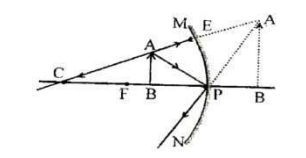
Q: If an object is placed between the centre of curvature and the focus of a concave mirror, determine the position, nature, and size of the image. Draw a ray diagram.
Ans: When the object is placed between the centre of curvature and the focus, the image is formed beyond the centre of curvature. It is real, inverted, and magnified.
Q: What is the refractive index? Write its mathematical expression.
Ans: The refractive index of a medium is the ratio of the speed of light in vacuum to the speed of light in that medium.
Mathematical expression: n = c/v
Q: Define the power of a lens. Write its mathematical expression and SI unit. HSLC ’20
Ans: The power of a lens is the reciprocal of its focal length.
Mathematical expression: P = 1/f (where f is in metres)
SI unit: Dioptre (D)
Q: The focal length of a plane mirror is—
(a) Zero
(b) Positive
(c) Negative
(d) Infinite
Ans: (d) Infinite
Q: The power of a lens is 2 dioptres. Its focal length is—
(a) 25 cm
(b) 100 cm
(c) 75 cm
(d) 50 cm
Ans: (d) 50 cm
Q: What is the dispersion of light? HSLC ’20
Ans: Dispersion of light is the splitting of white light into its seven constituent colours.
Q: In which medium is the speed of light maximum?
Ans: In a vacuum.
Q: Why is the colour of the sky blue?
Ans: Due to scattering of light.
Q: Find the power of a concave lens of focal length 2 m. Also, at what distance should an object be placed from a concave lens of focal length 15cm so that an image is formed at 10 cm? Also, find the magnification and nature of the image. HSLC ’19
Ans:
Power of lens: P = 1/f = 1/(−2) = −0.5 D
For second part:
Given: f = −15 cm, v = −10 cm
Using lens formula: 1/f = 1/v − 1/u
1/(−15) = 1/(−10) − 1/u
⇒ −1/15 = −1/10 − 1/u
⇒ −1/u = −1/15 + 1/10 = (−2 + 3)/30 = 1/30
⇒ u = −30 cm
Magnification: m = v/u = (−10)/(−30) = 1/3
Nature: Image is virtual, erect, and diminished.
Multiple Choice Questions (MCQ)
Q: To obtain a real image of the same size as the object in a concave mirror, where should the object be placed?
(a) Beyond the centre of curvature
(b) At the centre of curvature
(c) Between the centre of curvature and the focus
(d) At focus
Ans: (b) At the centre of curvature
Q: To obtain a real image of the same size using a convex lens, where should the object be placed?
(a) At infinity
(b) At principal focus
(c) At twice the focal length
(d) Between the optical centre and the focus
Ans: (c) At twice the focal length
Q: The mirror used as a shaving mirror is—
(a) Concave mirror
(b) Convex mirror
(c) Plane mirror
(d) Double convex mirror
Ans: (a) Concave mirror
Q: Where should an object be placed in a concave mirror so that the image is formed behind the mirror?
(a) At focus
(b) Beyond the centre of curvature
(c) Between focus and pole
(d) Between the focus and the centre of curvature
Ans: (c) Between focus and pole
Q: The image formed by a mirror is always erect regardless of the distance of the object. What type of mirror is it?
(a) Plane
(b) Concave
(c) Convex
(d) Either plane or convex
Ans: (d) Either plane or convex
Q: The mirror used as a rear-view mirror is—
(a) Concave mirror
(b) Convex mirror
(c) Plane mirror
(d) Double convex mirror
Ans: (b) Convex mirror
Q: The radius of curvature of a spherical mirror is 30 cm. Its focal length is—
(a) 30 cm
(b) 20 cm
(c) 10 cm
(d) 15 cm
Ans: (d) 15 cm
Q: A lens has power +2D. The lens is—
(a) Converging
(b) Diverging
(c) Both
(d) None
Ans: (a) Converging
Q: Which material cannot be used to make a lens?
(a) Water
(b) Glass
(c) Plastic
(d) Clay
Ans: (d) Clay
Q: A spherical mirror and a thin spherical lens each have a focal length of 15 cm. What is their nature?
(a) Both concave
(b) Both convex
(c) Mirror concave and lens convex
(d) Mirror convex and lens concave
Ans: (a) Both concave
Q: If the magnification has a negative sign, the image is—
(a) Real
(b) Virtual
(c) Erect
(d) Inverted
Ans: (d) Inverted
Q: The ratio of the speed of light in air to that in glass is—
(a) 1.50
(b) 1.25
(c) 1.33
(d) 1.30
Ans: (a) 1.50

