
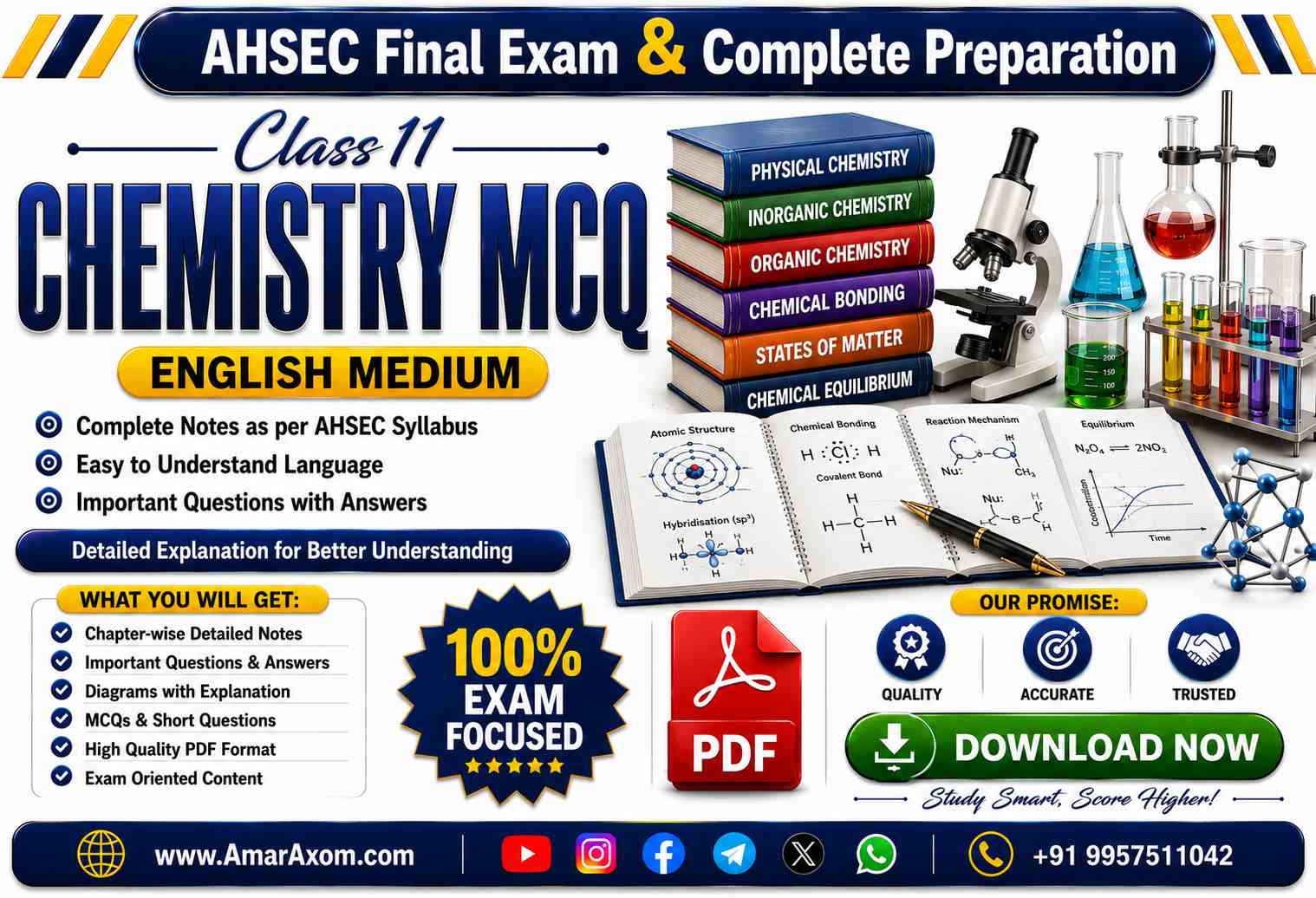
AHSEC Class 11 Chemistry MCQ Solutions English Medium
Are you looking for AHSEC Class 11 Chemistry MCQ Solutions English Medium 2027? Then you have come to the right place. This article provides chapter-wise Multiple Choice Questions (MCQs) with answers for AHSEC Higher Secondary First Year (HS 1st Year) students.
Our Chemistry MCQ solutions are prepared according to the latest AHSEC syllabus and examination pattern, helping students practice important objective questions from every chapter. These MCQs are designed to strengthen conceptual understanding, improve problem-solving abilities, and help students prepare effectively for school examinations and competitive tests.
Students will find important MCQs covering Physical Chemistry, Organic Chemistry, and Inorganic Chemistry topics, including atomic structure, chemical bonding, thermodynamics, equilibrium, hydrocarbons, and many other important chapters. Regular practice of these questions will help improve accuracy, increase confidence, and boost overall exam performance.
All questions and answers are presented in simple and easy-to-understand English, making them ideal for quick revision and self-assessment. Whether you are preparing for class tests, annual examinations, or the AHSEC Higher Secondary First Year Examination, these MCQ solutions will be a valuable resource for your Chemistry preparation.

| Class 11 Chemistry MCQ PDF Notes | Rs. 79/- | Buy Now |
Class 11 Chemistry MCQ Solutions
Part I
Chapter 1: Some Basic Concepts of Chemistry
- Importance of Chemistry
- Nature of Matter
- Properties of Matter and their Measurement
- Uncertainty in Measurement
- Laws of Chemical Combinations
- Dalton’s Atomic Theory
- Atomic and Molecular Masses
- Mole Concept and Molar Mass
- Percentage Composition
- Empirical and Molecular Formula
- Chemical Reactions
- Sub-atomic Particles
- Atomic Models
- Developments Leading to the Bohr’s Model
- Bohr’s Model for Hydrogen Atom
- Towards Quantum Mechanical Model of Atom
- Quantum Mechanical Model of Atom
- Electronic Configuration of Atoms
Chapter 3: Classification of Elements and Periodicity in Properties
- Why do we need to Classify Elements?
- Genesis of Periodic Classification
- Modern Periodic Law and the Present Form of the Periodic Table
- Nomenclature of Elements with Atomic Numbers > 100
- Electronic Configurations of Elements and the Periodic Table
- Electronic Configurations and Types of Elements
- Periodic Trends in Properties of Elements
Chapter 4: Chemical Bonding and Molecular Structure
- Kossel-Lewis Approach to Chemical Bonding
- Ionic or Electrovalent Bond
- Bond Parameters
- The Valence Shell Electron Pair Repulsion (VSEPR) Theory
- Valence Bond Theory
- Hybridisation
- Molecular Orbital Theory
- Bonding in Some Homonuclear Diatomic Molecules
- Hydrogen Bonding
- Intermolecular Forces
- Thermal Energy
- Intermolecular Forces vs Thermal Interactions
- The Gaseous State
- The Gas Laws
- Ideal Gas Equation
- Kinetic Molecular Theory of Gases
- Behaviour of Real Gases
- Liquefaction of Gases
- 10 Liquid State
- Thermodynamic Terms
- Applications of Thermodynamics
- Measurement of ΔU and ΔH
- Enthalpy Change
- Hess’s Law of Constant Heat Summation
- Enthalpies for Different Types of Reactions
- Spontaneity
- Gibbs Energy Change
- Equilibrium in Physical Processes
- Equilibrium in Chemical Processes
- Law of Chemical Equilibrium
- Equilibrium Constant
- Factors Affecting Equilibrium
- Ionic Equilibrium
- Acids, Bases and Salts
- Buffer Solutions
- Solubility Equilibria
Part II
- Classical Idea of Redox Reactions
- Redox Reactions in Terms of Electron Transfer
- Oxidation Number
- Types of Redox Reactions
- Balancing Redox Reactions
- Position of Hydrogen in the Periodic Table
- Occurrence
- Isotopes of Hydrogen
- Preparation and Properties of Hydrogen
- Hydrides
- Water
- Hydrogen Peroxide
- Heavy Water
- Hydrogen as a Fuel
Chapter 10: The s-Block Elements
- Group 1 Elements: Alkali Metals
- General Characteristics of the Compounds of Alkali Metals
- Anomalous Properties of Lithium
- Some Important Compounds of Sodium
- Biological Importance of Sodium and Potassium
- Group 2 Elements: Alkaline Earth Metals
- General Characteristics of Compounds of Alkaline Earth Metals
- Anomalous Behaviour of Beryllium
- Some Important Compounds of Calcium
Chapter 11: The p-Block Elements
- Group 13 Elements
- Important Trends and Anomalous Properties
- Chemical Properties
- Uses
- Group 14 Elements
- Compounds and Properties
Chapter 12: Organic Chemistry – Some Basic Principles and Techniques
- General Introduction
- Tetravalency of Carbon
- Structural Representations of Organic Compounds
- Classification of Organic Compounds
- Nomenclature of Organic Compounds
- Isomerism
- Fundamental Concepts in Organic Reaction Mechanism
- Methods of Purification
- Qualitative Analysis
- Quantitative Analysis
- Classification
- Alkanes
- Alkenes
- Alkynes
- Aromatic Hydrocarbons
- Carcinogenicity and Toxicity
Chapter 14: Environmental Chemistry
- Environmental Pollution
- Atmospheric Pollution
- Water Pollution
- Soil Pollution
- Industrial Wastes
- Strategies to Control Environmental Pollution.
SALIENT FEATURES
- Our Books are written by a Board of Experienced and Especially Trained Writers.
- Our books are unique in planning and presentation of the subject matters.
- Our language and style are very easy to grasp and to bear in mind.
- The arrangement of the contents of our books is very systematic.
- Our books contain the solution of all the textual and probable questions from the examination point of view.
- Our question-answers are to the point.
- Our books contain no prolixity.
- Our Ready Guide (notes) contains 100% common questions.
- Our books are being reviewed by skilled critics and experts.
- Our books contain the solutions of all previous exam question papers.
- We honour, consider and execute the suggestions, criticisms, opinions, public reviews and feedback of any kind.
- If the examinees (students) practise the question-answers given in this Ready Guide, we ensure that they would be able to solve any question asked in the examination.

