Session 1: Basic Geometric Constructions
Unit 1: Engineering Drawing
Textual Question-Answers
Check Your Progress
A. Fill in the blanks
1. The understanding of plane geometry is a prerequisite for theproper use of …………………
Ans: drawing instruments
2. A plane figure surrounded by ………………… forms a triangle.
Ans: three straight lines
3. A scalene triangle is formed by three ………………… sides andthree …………………
Ans: unequal, unequal angles
4. A figure bounded by ………………… sides is called quadrilateral.
Ans: four
5. A quadrilateral with ………………… sides is called rhombus.
Ans: all four equal
6. A plane figure bounded by more than ………………… sides iscalled a polygon.
Ans: four
7. A plane figure bounded by ………………… sides is called aheptagon.
Ans: seven
8. A plane figure bounded by ………………… sides is called adecagon.
Ans: ten
B. State whether the following statements are true or false
1. Bisecting the line means dividing the line into two equal parts.
Ans: True
2. If one line is perpendicular to another line, they intersect eachother at 45°.
Ans: False
3. A triangle having all three sides equal is called an equilateral riangle.
Ans: True
4. A plane figure with more than five sides is called a quadrilateral.
Ans: False
5. A quadrilateral with all four equal sides is called a rhombus.
Ans: True
6. A quadrilateral with one pair of opposite side parallel is called atrapezium.
Ans: True
7. A plane figure bounded by eight sides is called a heptagon.
Ans: False
8. A plane figure bounded by nine sides is called a nonagon.
Ans: True
C. Multiple choice questions
1. Which method is used for drawing various geometric shapes?(a) Geometric construction
(b) Polygon method
(c) Contour method
(d) None of the above
Ans: (a) Geometric construction
2. An isosceles triangle has………………(a) two equal sides and angles
(b) two equal sides and angles
(c) three equal sides and angles
(d) None of the above
Ans: (a) two equal sides and angles
3. An equilateral triangle is formed by………………….
(a) equal sides and equal angles
(b) only equal sides
(c) only angles
(d) No equal side or angle
Ans: (a) equal sides and equal angles
4. What is the sum of all three interior angles of a triangle equal to?(a) 180 degree
(b) 90 degree
(c) 360 degree
(d) 60 degree
Ans: (a) 180 degree
5. A figure bounded by four straight sides is called a………………(a) quadrilateral
(b) square
(c) triangle
(d) equilateral triangle
Ans: (a) quadrilateral
D. Answer the following questions
1. Why are geometric constructions important in making drawings?
Ans: Geometric constructions are important in making drawings becausethey help in drawing accurate lines, angles, and shapes using drawinginstruments. They ensure precision and correctness in technical andengineering drawings.
2. What are the steps required for dividing a straight line into sevenequal parts?
Ans: The steps required for dividing a straight line into seven equal paresare as follows:
First, draw a straight line AB.
From point A, draw a ray at any convenient angle.
On the ray, mark seven equal points using a compass.
Join the last marked point to B.
Draw lines parallel to this joining line from the remaining marked points.
The line AB is divided into seven equal parts.
3. Differentiate between a triangle and a quadrilateral.
Ans: A triangle has three sides and three angles, whereas a quadrilateral hasfour sides and four angles. The sum of the interior angles of a triangle is 180°, while the sum of theinterior angles of a quadrilateral is 360°.
4. Differentiate between a quadrilateral and a polygon.
Ans:
A quadrilateral is a plane figure having four sides, whereas a polygon is aplane figure having more than four sides.
All quadrilaterals are polygons, but all polygons are not quadrilaterals.
5. List the steps for making a polygon with 10 equal sides.
Ans:
Draw a circle with a suitable radius.
Divide the circle into ten equal parts by marking angles of 36° each at thecentre.
Mark the points on the circumference.
Join the consecutive points with straight lines.
The figure obtained is a regular polygon with ten equal sides.
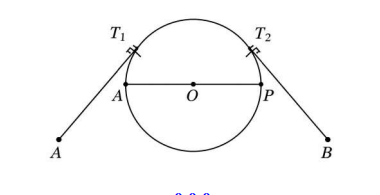
6. Draw tangents from a given point lying on the diameter of thecircle to the circle.
Ans:
Draw a circle with centre O and diameter AB.
Mark a point P on the diameter AB such that it lies on the circle.
Join OP.
At point P, draw a line perpendicular to OP.
The perpendicular line at point P is the required tangent to the circle.