

If you are a Class XII student searching for high-quality AHSEC Class 12 Economics Chapter 5 Balance of Payments notes to improve your exam performance, then this Ready Guide is for you. It includes all the important question-answers prepared by a team of experts. Our language is very easy to understand and remember. Begin your study journey with us for a bright future.
Class 12 Economics Chapter 5 Balance of Payments
Selected Questions & Answers
A. Very Short Answer Questions: (Marks for each – 1)
1. Define open economy.
Ans: An economic system in which two or more countries establish economic relations with the international economic system is called an open economy.
2. When the given import function is M = 50 + 0.4Y, what will bethe marginal propensity to import?
Ans: The marginal propensity to import will be 0.4.
3. Is it possible for a country to have both a trade deficit and acurrent account deficit at the same time?
Ans: Yes.
4. What are the two main accounts shown in the statement of foreign transactions?
Ans: The two main accounts shown in the statement of foreign transactions are:
(a) Current account
(b) Capital account
5. What is meant by Balance of Payments?
Ans: When a country systematically records all economic transactions with other countries within a specific period, such transactions are called the Balance of Payments.
6. What is the international exchange theory which states that the price of the same commodity is the same in different countries?
Ans: Purchasing Power Parity Theory.
7. In the equation Y = C + I + G + Nx, what does Nx indicate?
Ans: Nx indicates net exports in foreign trade.
8. What is real exchange rate?
Ans: When the ratio of foreign prices and domestic prices is measured through currency, it is called the real exchange rate.
9. What is Balance of Payments equilibrium?
Ans: The detailed record of all financial transactions between a country and the rest of the world during a specific period is called the Balance of Payments.
10. What is invisible trade? H S ’17
Ans: The exchange of intangible and non-transferable items is called invisible trade.
11. What is Purchasing Power Parity?
Ans: Purchasing Power Parity means equality of purchasing power in exchange rates between two countries. That is, when the commodities of two countries are compared through currency exchange, the monetary expenditure on commodities in both countries should be equal.
12. What is transfer payment or transfer expenditure? H S ’19
Ans: The income that the people of a country receive freely without providing any present or future service in return is called transfer payment. For example: donation, gift, etc.
13. The exchange rate of rupee and dollar is 55 rupees. What doesthis information indicate?
Ans: The information “the exchange rate of rupee and dollar is 55 rupees” indicates that 55 rupees are required to purchase one dollar.
14. Define foreign exchange rate. H S ’15, ’17
Ans: The monetary exchange that takes place between two countries is called the foreign exchange rate.
15. Mention any one major participant of the foreign exchange market.
Ans: Commercial banks.
16. What is foreign exchange market?
Ans: The foreign exchange market is a market where the currencies of different countries are exchanged.
17. Mention two causes of BOP disequilibrium.
Ans: Two causes of BOP disequilibrium are:
(a) Rise and fall of trade cycles
(b) Political instability
18. What is meant by BOP disequilibrium?
Ans: When the debit and credit sides of a country’s Balance of Payments account are not equal, BOP disequilibrium arises.
19. Mention two measures to remove BOP disequilibrium are:
Ans: Two measures to remove BOP disequilibrium.
(a) Promotion of exports
(b) Devaluation of domestic currency
20. What is visible account in the Balance of Payments?
Ans: In the Balance of Payments, the visible account includes imported and exported goods such as machinery, cloth, etc.
21. When does a deficit arise in the balance of foreign trade?
Ans: When the value of exports is less than the value of imports.
22. Give one example of current account in foreign transactions.
Ans: Exported and imported goods.
23. Define closed economy.
Ans: An economic system that has no relationship with the international economic system is called a closed economy.
24. Mention one item included in the capital account of foreign trade transactions.
Ans: Government loans and capital.
25. Write the meaning of devaluation of currency. H S ’16
Ans: When the foreign value of a country’s currency decreases and that decrease is officially recognized by the government, it is called devaluation.
26. What is the full form of PPP?
Ans: Purchasing Power Parity.
27. On what basis is REER calculated?
Ans: It is calculated on the basis of the real exchange rate.
28. What is the full form of REER?
Ans: Real Effective Exchange Rate.
29. What is the full form of NEER?
Ans: Nominal Effective Exchange Rate.
30. What is the full form of WTO?
Ans: World Trade Organization.
31. What is meant by international liquidity?
Ans: International liquidity refers to the international means of payment.
32. Write True or False:
(a) Total foreign trade as a proportion of GDP is a common measure of the degree of openness of an economy.
Ans: True.
(b) There exists a single currency issued by a central authority at the international level.
Ans: False.
(c) A positive Nx indicates trade surplus.
Ans: True.
(d) At the international level there is a specific currency printed by a fixed central monetary authority.
Ans: False.
(e) The openness of an economy is measured by the total foreign quantity added to the Gross Domestic Product.
Ans: False.
33. What is Balance of Payments equilibrium? H S ’18
Ans: The system through which it can be determined whether there is adeficit or surplus in foreign transactions and through which the deficit or surplus can be corrected is called Balance of Payments equilibrium.
B. Short Answer Questions: (Marks for each – 2)
1. Mention the factors determining foreign exchange rate.
Ans: The factors determining foreign exchange rate are:
(a) Profit motive
(b) Income
(c) Rate of interest
(d) Long-term exchange rate and purchasing power parity.
2. Mention two factors on which import demand depends.
Ans: Two factors on which import demand depends are:
(a) Domestic income and
(b) Real exchange rate.
3. Mention two measures to correct deficit in foreign trade transactions.
Ans: If a deficit arises in foreign trade transactions, two measures to correct it are:
(a) Reduction of foreign exchange reserves and
(b) Borrowing from the International Monetary Fund.
4. Mention the sources of demand for domestic goods in a closed economy.
Ans: The sources of demand for domestic goods in a closed economy are:
(a) Consumption
(b) Government expenditure
(c) Domestic investment.
5. In the context of an open economy, explain the meaning of market integration, financial market integration, and factor market integration.
Ans: Due to international trade, consumers and firms get the opportunity to choose between different types of domestic and foreign goods. This is called market integration. Investors get the opportunity to choose between domestic and foreign assets; this creates financial market integration. Firms can decide where to establish their production units according to their preference and workers can choose where to work. This is called factor market integration.
6. Which two international institutions are referred to as the “BrettonWoods Twins”?
Ans: The “Bretton Woods Twins” refer to the International Monetary Fund and the World Bank.
7. What are the two main accounts of the Balance of Payments? HS ’18
Ans: The two main accounts of the Balance of Payments are — Current account and Capital account.
8. What is variable cost? Why is the Average Variable Cost (AVC)curve U-shaped? H S ’19
Ans: In the production process, the cost of those factors which increaseor decrease with the increase or decrease of production is called variable cost. Example: raw materials. At the initial stage of production, due to increased use of variable factors, division of labour and specialization increase average product and reduce cost. But after a certain stage, diseconomies arise and division of labour ends. As a result, average product decreases and average cost increases. Therefore, the AVC curve becomes U-shaped.
9. Write two advantages of fixed exchange rate.
Ans: Two advantages of fixed exchange rate are:
(a) Fixed foreign exchange rate promotes expansion of a country’s import and export trade.
(b) Fixed exchange rate helps maintain internal economic stability.
C. Medium Answer Questions: (Marks for each – 4)
1. Mention four features of Balance of Payments. H S ’15
Ans: The four features of Balance of Payments are:
(a) Balance of Payments is a systematic record of transactions between a country and the rest of the world.
(b) Such an account is prepared every year.
(c) The Balance of Payments account is double-entry in nature.
(d) In this account, both debit and credit items of international transactions are included.
2. Mention three measures to correct disequilibrium in foreign trade transactions.
Ans: Three measures to correct disequilibrium in foreign trade transactions are:
(a) By changing imports and exports.
(b) By changing the supply of money.
(c) By changing the prices of goods and the level of economic activities.
3. Mention four advantages of flexible exchange rate.
Ans: Four advantages of flexible exchange rate are:
(a) It helps determine equilibrium in a country’s foreign trade transactions.
(b) Under this system, the central bank does not need to maintain large international reserves.
(c) It helps solve the problem of shortage and surplus of currencies of different countries.
(d) It helps in the smooth functioning of the trade system and removes obstacles in the movement of capital.
4. Which items are included in the current account of Balance of Payments?
Ans: The items included in the current account of Balance of Payments are:
(a) Travel expenditure relating to trade, education, health, international conferences, etc.
(b) Insurance transactions.
(c) Transportation expenses.
(d) Government transactions.
(e) Investment income, etc.
5. Which items are included in the capital account of Balance of Payments?
Ans: The items included in the capital account of Balance of Payments are: foreign loans, capital investment by foreigners, sale of assets to foreigners, loans given to foreign institutions, capital investment abroad, purchase ofassets from abroad, etc.
6. Explain the Bretton Woods system.
Ans: The Bretton Woods system is a fixed exchange rate system, though it may also be adjustable. The main features of this system are:
(a) The currencies of different countries are linked with the US dollar.
(b) Gold is considered the ultimate unit of parity between two currencies.
(c) The US dollar is given a fixed gold value.
(d) The value of a country’s currency in terms of the dollar indicates its value in terms of gold.
(e) The parity value of a country’s currency can be changed with the approval of the International Monetary Fund.
7. Show the difference between devaluation and depreciation.
Ans: The process by which the government of a country officially reducesthe value of its domestic currency in relation to foreign currencies or gold is called devaluation. Devaluation is carried out through government orders and is usually adopted when a country continuously faces deficit in its foreign trade balance. On the other hand, depreciation refers to the fall in the external value of a country’s currency due to market forces under a flexible exchange rate system. Depreciation occurs on the basis of demand and supply of foreign exchange. Devaluation occurs in a fixed exchange rate system, whereas depreciation occurs in a flexible exchange rate system.
8. What is managed floating exchange rate? Explain.
Ans: Since 1971, most countries have adopted the managed floating exchange rate system. It is a combination of fixed exchange rate and flexible exchange rate systems. This system is also called “dirty floating”. In this system, a country’s currency is allowed to float in the foreign exchange market and the exchange rate is determined by market forces. However, it does not mean that there is no government intervention. When necessary, the monetary authority of the country may intervene to prevent excessive fluctuations in the exchange rate. By buying or selling foreign currencies, the monetary authority tries to maintain stability in exchange rate movements. Therefore, official reserve transactions are not equal to zero.
9. How is exchange rate determined under the gold standard system?
Ans: The gold standard system is a type of fixed exchange rate system. Under this system, the value of the currencies of all countries is expressed interms of gold. Each participating country commits to express its currency at afixed value in terms of gold. In foreign trade, the currencies of participating countries may be gold coins or other metallic currencies, but they must be convertible into gold. The gold standard system prevailed roughly from 1870to 1914. During this period, exchange rates remained stable. However, in the inter-war period between the two World Wars, instability and uncertainty in international trade appeared. As a result, the gold standard system collapsedand inflationary conditions emerged.
10. What is devaluation of currency?
Ans: Devaluation of currency refers to the process by which the government of a country officially reduces the value of its domestic currency in relation to foreign currencies or gold. This reduction is carried out through government orders. When a country continuously faces deficit in its foreign trade balance, it may adopt the policy of devaluation. In such a situation, devaluation tends to increase exports and reduce imports. As a result, the deficit in international transactions decreases and the balance may move towards equilibrium.
11. Explain the role of speculation in determining flexible exchange rate.
Ans: In a flexible exchange rate system, speculation plays an important role in determining exchange rates. When people expect the value of a foreign currency to rise, they increase their demand for that currency in anticipation of future profit. For example, if the value of the US dollar is expected to rise in comparison with the rupee, people will try to hold dollars. This increases the demand for dollars. The increased demand for dollars leads to a rise in the exchange rate between the rupee and the dollar. Thus, speculators increase the demand for particular currencies expecting higher future profits, and this demand influences the fluctuations in foreign exchange rates.
12. Show the difference between fixed and flexible exchange rates. H S ’16
Ans: The difference between fixed and flexible exchange rates is:
(a) A fixed exchange rate remains stable for a long period of time. But a flexible exchange rate changes frequently.
(b) Under a fixed exchange rate, the foreign exchange value of a country’s currency is officially determined by the government at a specific rate. On the other hand, a flexible exchange rate is determined by the forces of demand and supply of foreign exchange in the market.
D. Essay Type Questions: (Marks for each – 6)
1. Explain with the help of a diagram how the exchange rate is determined under a flexible exchange rate system.
Ans: In international trade, under a flexible exchange rate system, the exchange rate is determined by the forces of demand and supply. In such a system, the exchange rate of a country depends on the demand and supply of that country’s currency. If the demand for foreign currency increases, its market price rises. Again, if the demand for foreign currency decreases, its value also falls. Generally, the demand for foreign currency depends on factors such as investment in other parts of the world, repayment of international loans, and gifts and grants to other countries. On the other hand, the supply offoreign currency depends on foreign direct investment, purchases made for profit, etc. The point at which the demand and supply of foreign exchange become equal determines the equilibrium exchange rate and the equilibrium quantity of foreign currency. The situation of determining the equilibrium exchange rate is explained with the help of a diagram.
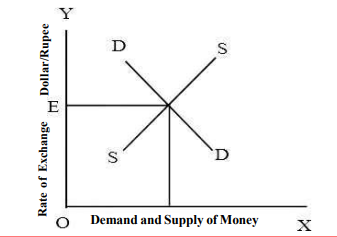
In the diagram, the vertical OY axis measures the domestic currency (such as US dollars and Indian rupees) and the horizontal OX axis shows the demand and supply of foreign exchange. In the diagram, the demand curve is downward-sloping. It shows that when the exchange rate is high, the quantity demanded of foreign exchange is low. In such a situation, the volume of imports decreases. On the other hand, the supply curve SS slopes upward. It indicates that when the exchange rate increases, the supply of foreign exchange also increases. In this case, domestic goods become cheaper compared to foreign goods, which increases the demand for domestic goods and raises exports. In the diagram, the demand curve and the supply curve intersect at point E, where the equilibrium exchange rate is determined. Thus, under a flexible exchange rate system, the exchange rate is determined.
2. Explain the concepts of autonomous and accommodating transactions in Balance of Payments. H S ’15, ’17
Or
Write the difference between autonomous transactions and accommodating transactions in Balance of Payments.
Ans: When a country undertakes international economic transactions without considering the condition of Balance of Payments, such transactions are called autonomous transactions. These transactions are carried out independently for economic motives such as profit, trade, or investment. Example: transactions undertaken solely for earning profit. If the autonomous receipts of a country are less than its autonomous payments, then a deficit in the Balance of Payments arises. On the other hand, accommodating transactions are those transactions that are undertaken to correct the imbalance in Balance of Payments. These transactions occur as a result of the overall outcome of a country’s international transactions. For example, if the Balance of Payments of Pakistan shows adeficit of 300000 dollars, the country will have to borrow this amount. This borrowing arises because of the deficit created by autonomous transactions. Therefore, such borrowing is an accommodating transaction.

